Firebase Pricing in 2026: What You Actually Pay
Firebase pricing in 2026 is free to start (Spark: 50K Firestore reads a day) then pay-as-you-go on Blaze at $0.06 per 100K reads, with no hard spending cap. New in 2026: Firestore now ships in two editions (Standard and Enterprise), SQL Connect adds a fixed floor from about $9.37/month, and App Hosting has its own bandwidth meter. Three real 30-day bills inside.
Updated on September 15, 2026

On this page

Updated September 15, 2026. Every Spark quota and Blaze rate below was re-verified against Firebase's official 2026 pricing page and Google's Firestore billing example on this date, and all four Standard rates are unchanged: $0.06 per 100,000 reads, $0.18 per 100,000 writes, $0.02 per 100,000 deletes, $0.18 per GiB stored (US multi-region; a single region such as us-central1 is roughly half that). Corrected this pass: Cloud Functions and Cloud Storage were listed as Spark free-tier quotas, and both are Blaze-only. New this pass: the two Cloud Storage bucket regimes, whose no-cost download allowances differ by 100x. Firestore Enterprise and SQL Connect figures were re-read from Google's own docs on September 15, 2026.
Correction, September 15, 2026: the Spark free-tier table and the quick answer below originally listed Cloud Functions at 2,000,000 invocations per month and Cloud Storage at 5 GB stored with 1 GB per day of download as Spark allowances. They are not. Firebase's own pricing table marks the Spark column Not applicable for every Cloud Functions and Cloud Storage row, and those figures sit in the Blaze column. Firebase's docs are explicit on both: "to deploy functions, your project must be on the Blaze pricing plan", and "Make sure your Firebase project is on the pay-as-you-go Blaze pricing plan, which is a requirement to use Cloud Storage for Firebase." Every Firestore, Hosting and Realtime Database quota on this page was re-checked against the same table and is unchanged. The three worked bills are all Blaze bills and were not affected.
Quick answer: Firebase pricing in 2026
Firebase's Spark plan is free and stays free within daily quotas. As of 2026, Cloud Firestore on Spark gives you 50,000 document reads, 20,000 writes, and 20,000 deletes per day, plus 1 GiB stored and 10 GiB/month network egress. Hosting adds 10 GB of storage and 360 MB per day of transfer, and the Realtime Database 1 GB stored. Cloud Functions and Cloud Storage are not on Spark at all: both require Blaze, so the widely quoted 2 million invocations per month and 5 GB stored are Blaze no-cost allowances rather than free-plan quotas. Cross those quotas and you move to the pay-as-you-go Blaze plan, which keeps the Spark allowances, unlocks the products Spark cannot run, then charges per unit: $0.06 per 100,000 Firestore reads, $0.18 per 100,000 writes, $0.02 per 100,000 deletes, and $0.18 per GiB stored per month. A typical 5,000 daily-active-user app runs about $12/month. The catch: Firebase has no hard spending cap, so one unbounded query can turn that $12 into thousands overnight. New in 2026, Firebase also has a fixed-floor option, SQL Connect, from about $9.37/month, and a second Firestore edition (Enterprise) priced in size-based units rather than per document.
Firebase Spark (free) tier limits, 2026
Scroll to see more
| Metric (Spark free tier, 2026) | Free allowance |
|---|---|
| Firestore document reads | 50,000 per day |
| Firestore document writes | 20,000 per day |
| Firestore document deletes | 20,000 per day |
| Firestore stored data | 1 GiB total |
| Firestore network egress | 10 GiB per month |
| Cloud Functions invocations | not on Spark, Blaze only |
| Cloud Storage stored | not on Spark, Blaze only |
| Cloud Storage download | not on Spark, Blaze only |
| Hosting storage | 10 GB |
| Hosting data transfer | 360 MB per day |
| Realtime Database stored | 1 GB |
| Realtime Database download | 10 GB per month |
Firestore Blaze rates above the free quota, 2026
Scroll to see more
| Meter (Firestore Standard, US multi-region, 2026) | Blaze price above free quota |
|---|---|
| Document reads | $0.06 per 100,000 |
| Document writes | $0.18 per 100,000 |
| Document deletes | $0.02 per 100,000 |
| Stored data | $0.18 per GiB per month |
| Network egress | $0.12 per GiB |
What changed in Firebase pricing for 2026
Most pages ranking for "firebase pricing" still describe the Firebase of 2023: one Firestore rate card, the retired Flame plan, and the old "no fixed price, no hard cap" summary. Four things changed by 2026, and each one moves real money.
Firestore now ships in two editions. The classic per-document meter is now called Firestore Standard edition. Google added an Enterprise edition (MongoDB-compatible) that prices in size-based units, not documents. Google's Firestore Enterprise pricing charges reads in 4 KiB read units at $0.05 per million read units and writes in 1 KiB write units at $0.26 per million, and it adds an index-write charge per indexed field that Standard includes for free. An 8 KiB document costs 2 read units on Enterprise versus 1 read on Standard. Enterprise wins for tiny 1 to 2 KiB documents and loses for large, heavily indexed ones. A teardown that only quotes "$0.06 per 100,000 reads" now describes just one of the two editions.
Firebase added a fixed-minimum backend: SQL Connect. For years the knock on Firebase was that everything was metered and nothing was predictable. Firebase SQL Connect, managed Cloud SQL for PostgreSQL, breaks that. The smallest instance, a db-f1-micro with 1 vCPU, 10 GB storage, and about 628 MB of memory, runs about $9.37/month whether or not anyone uses it, plus $0.90 per million operations above a free 250,000 per month. Blaze accounts get a 3-month trial (five per billing account). That flips the risk shape: you trade Firestore's runaway-read tail for a base you pay even at zero traffic.
Firebase App Hosting has its own bandwidth meter. App Hosting, the managed full-stack option built on Cloud Run, bills compute plus bandwidth, with the first 10 GiB per month of bandwidth free as of August 1, 2025, per the 2026 pricing page. It is a separate line from Hosting's older 10 GB storage and 360 MB/day transfer allowances, and the two are easy to conflate on a bill.
Firebase Studio is scheduled to shut down on March 22, 2027. The AI app-building workspace launched in April 2025 and is being retired. It does not change the rate card, but it is the Firebase pricing question people keep asking in 2026, so to be clear: Studio going away does not touch your Firestore, Functions, or Hosting bill.
Scroll to see more
| Newer Firebase surface (2026) | How it is priced | Notable number |
|---|---|---|
| Firestore Standard edition | per document read, write, delete | $0.06 / 100K reads (US multi-region) |
| Firestore Enterprise edition | per size-based unit (4 KiB reads, 1 KiB writes) plus index writes | $0.05 / million read units |
| Firebase App Hosting | Cloud Run compute plus bandwidth | 10 GiB/month bandwidth free (since Aug 1, 2025) |
| Firebase SQL Connect | fixed Cloud SQL instance plus operations | from about $9.37 / month base |
What does Firebase cost in 2026?
Firebase has two plans. Spark is free and stays free within daily quotas. Blaze is pay-as-you-go: you keep the Spark allowances, unlock two products Spark cannot run at all, then pay per unit above the no-cost tier. Here is what each plan covers in 2026, pulled from Firebase's 2026 pricing page.
Scroll to see more
| Product | Free (Spark) allowance | Blaze overage |
|---|---|---|
| Cloud Firestore | 50K reads, 20K writes, 20K deletes per day; 1 GiB stored | per operation, see next table |
| Cloud Storage | not available, Blaze only | legacy bucket: 5 GB stored and 1 GB/day download at no cost, then $0.026/GB stored, $0.12/GB downloaded |
| Cloud Functions | not available, Blaze only | 2M invocations/month at no cost, then $0.40 per million invocations |
| Hosting | 10 GB stored, 360 MB/day transfer | $0.026/GB stored, $0.15/GB transferred |
| Realtime Database | 1 GB stored, 10 GB/month downloaded | $5/GB stored, $1/GB downloaded |
The two Cloud Storage buckets are metered differently, 2026
Cloud Storage is the one line where Firebase quietly runs two rate cards at once, and the gap between them is large enough to change a plan. Both are Blaze-only. The split is by bucket, not by plan.
Scroll to see more
| Meter (Blaze no-cost allowance, 2026) | *.appspot.com legacy bucket | *.firebasestorage.app and additional buckets |
|---|---|---|
| Stored | 5 GB, then $0.026/GB | 5 GB-months, then Cloud Storage pricing |
| Downloaded | 1 GB per day, then $0.12/GB | 100 GB per month, then Cloud Storage pricing |
| Upload operations | 20,000 per day, then $0.05 per 10,000 | 5,000 per month, then Cloud Storage pricing |
| Download operations | 50,000 per day, then $0.004 per 10,000 | 50,000 per month, then Cloud Storage pricing |
Three things follow, and none of them is on the summary line anyone quotes.
The download allowance differs by roughly 100x, in the newer bucket's favour. The legacy bucket gives 1 GB a day, about 30 GB a month. The newer default bucket gives 100 GB a month outright. If you serve images or video, that is the difference between paying egress in week one and not paying it at all.
The meters flip from daily to monthly, and that changes the failure mode. A daily cap is a throttle: burn it by lunchtime and you are billed for the rest of the day, every day. A monthly cap is a budget you can spend unevenly. Identical-looking allowances behave nothing alike under a traffic spike.
The newer bucket's no-cost quota is regional. Firebase's pricing page carries the restriction in its own note: no-cost quotas are available only for buckets in us-central1, us-west1 and us-east1. Put the bucket in Europe or Asia and the allowance is simply not there, which is the single easiest way to turn a free storage line into a billed one. Billing also routes differently: the legacy *.appspot.com bucket bills as Google App Engine usage, while the newer default bucket and any additional buckets bill as Google Cloud Storage usage.
Two products dominate almost every Firebase bill: Cloud Firestore and Cloud Functions. The rest are usually rounding error until you serve large files or heavy traffic. So the number that matters is the Firestore rate card.
The Firestore rate card that actually drives your bill
Firestore does not charge for storage the way most databases do. It charges for operations: every document your app reads, writes, or deletes is metered. Here are the 2026 Blaze rates from Google's own worked billing example, for the United States multi-region on Standard edition.
Scroll to see more
| Meter | Free daily quota | Blaze price above quota |
|---|---|---|
| Document reads | 50,000 / day | $0.06 per 100,000 |
| Document writes | 20,000 / day | $0.18 per 100,000 |
| Document deletes | 20,000 / day | $0.02 per 100,000 |
| Stored data | 1 GiB | $0.18 per GiB / month |
| Network egress | 10 GiB / month | $0.12 per GiB |
Reads are the cheapest per unit and the most dangerous, because a real app does far more reads than writes, and it is trivially easy to read thousands of documents by accident. Hold that thought.
Firestore Standard vs Enterprise: the full 2026 rate comparison
The two editions are not two price points on one meter. They meter different things, and swapping edition can move a bill in either direction by an order of magnitude. Every Enterprise figure below is from Google's Firestore Enterprise pricing page, read August 24, 2026.
Scroll to see more
| Meter | Standard edition | Enterprise edition |
|---|---|---|
| Reads | $0.06 per 100,000 documents, so $0.60 per million | $0.05 per million 4 KiB read units |
| Writes | $0.18 per 100,000 documents, so $1.80 per million | $0.26 per million 1 KiB write units |
| Deletes | $0.02 per 100,000, so $0.20 per million | billed as write units, no cheap delete rate |
| Index writes | included | charged as write units per indexed field |
| Real-time updates | billed as ordinary document reads | $0.30 per million read units, billed separately |
| Stored data | $0.18 per GiB / month | $0.00032 per GiB-hour, about $0.234 per GiB / month |
| Backup storage | billed separately | $0.00004 per GiB-hour, about $0.029 per GiB / month |
| PITR storage | billed separately | $0.00020 per GiB-hour, about $0.146 per GiB / month |
| Free daily quota | 50,000 reads, 20,000 writes, 20,000 deletes, 1 GiB | 50,000 read units, 40,000 write units, 50,000 real-time update units, 1 GiB |
Four things in that table are missed by essentially every Firebase pricing roundup, and three of them are not in Google's own summary either.
Enterprise reads are up to 12 times cheaper, not more expensive. The usual framing is that an 8 KiB document costs 2 read units on Enterprise versus 1 read on Standard, which sounds like a penalty. It is not, because the unit prices differ. One million reads of a document under 4 KiB costs $0.05 on Enterprise and $0.60 on Standard. Firestore's maximum document size is 1 MiB, but the crossover sits at about 44 to 48 KiB of document, far above what almost anyone stores. On reads, Enterprise wins nearly always.
Writes flip the other way at about 7 KiB. Enterprise charges $0.26 per million 1 KiB write units, so a 1 KiB document costs $0.26 per million writes against Standard's $1.80. Enterprise stays cheaper until the document crosses roughly 6.9 KiB, where ceiling-rounded write units overtake the flat Standard rate.
Indexes are what actually move the crossover, and they move it a long way. On Enterprise, indexing a field consumes its own write units: indexing a 2 KiB string field costs 2 write units on every write. Take a 2 KiB document. Bare, it is 2 write units, $0.52 per million. Add one indexed 2 KiB field and it is $1.04. Add a second and it is $1.56. Add a third and it is $2.08 per million, now above Standard's $1.80. A heavily indexed collection can cross over at a document size where the raw write cost looked like a bargain.
Deletes get worse, and nobody budgets for it. Standard deletes are the cheapest meter on the platform at $0.20 per million. Enterprise has no delete rate at all: a delete costs write units. A 1 KiB document delete is $0.26 per million, a 30% premium. A 5 KiB document delete is 5 write units, $1.30 per million, six and a half times Standard. If your workload has a TTL sweep or a nightly purge, price it before you migrate.
Storage is the quiet one. Enterprise publishes storage per GiB-hour rather than per GiB-month, which makes it look cheaper than it is. At 730 hours in an average month, $0.00032 per GiB-hour is $0.234 per GiB per month against Standard's $0.18, about 30% more for the same bytes.
Real-time updates deserve a caveat in both directions. On Enterprise they are a separate line at $0.30 per million read units, six times Enterprise's own regular read rate, which reads badly. But on Standard a listener snapshot is billed as a full document read at $0.60 per million, so Enterprise real-time is still half the price. The reason to care is variance, not level: on Enterprise a chatty listener shows up on its own meter, where on Standard it is buried inside the read line that already drives the bill.
Math check: Enterprise is the cheaper edition for small documents, light indexing, and read-heavy traffic, and it is the more expensive one for large documents, wide indexes, heavy deletes, and large stored volumes. There is no general answer. Multiply your own median document size by your own index count before assuming either direction.
Firebase SQL Connect pricing in 2026

Scroll to see more
| Line | Blaze plan | Spark plan |
|---|---|---|
| Instance | from about $9.37 / month, default is 1 vCPU, 10 GB storage, 628.74 MB memory | trial instance only |
| Operations | 250,000 / month free, then $0.90 per million | capped at 8,300 / day, no charge |
| Network egress | 10 GiB / month free, then Google Cloud Premium Tier data transfer rates | 330 MiB during trial |
| Free trial | 3 months of the default Cloud SQL configuration, 5 trials per billing account | 90 days, one trial instance per project lifetime |
| Vertex AI embeddings | billed separately at standard Vertex AI rates | billed separately |
Two of those lines matter more than the headline price.
The Spark trial is once per project, forever. Not once per year and not once per billing account: one trial instance per project lifetime, 90 days, with roughly 8,000 operations a day and 330 MiB of egress. Burn it on a throwaway prototype and that project never gets another. The end of the trial is not a soft landing either: if the project is not on Blaze by day 90 the instance is archived and stops serving apps, and if it is still not on Blaze 90 days after that, it is deleted. On Blaze you get five trials per billing account, which is the number to plan around if you are spinning up several environments.
An operation is a query, not a row. This is the whole economic argument for SQL Connect and it is almost always stated wrong. A screen that pulls 200 documents costs 200 document reads on Firestore, about $0.00012 at the Standard rate. The same screen against SQL Connect is one operation, and the first 250,000 operations a month are free. Above the free tier, SQL Connect operations are $0.90 per million against Firestore reads at $0.60 per million, so SQL Connect is 50% more expensive per unit. It wins anyway, because a relational query collapses a fan-out read into a single billable event. The runaway getDocs() failure mode that produces the $5,540 bill later in this teardown does not have an equivalent here.
Where is the break-even? The $9.37 monthly floor buys you about 15.6 million Firestore document reads at $0.60 per million, or roughly 520,000 reads a day. Below that, Firestore is cheaper and often free. Above it, you are paying SQL Connect's floor for a bill that cannot spike from a missing .limit().
Math check: SQL Connect does not make Firebase cheaper. It makes Firebase predictable, by moving you from an unbounded per-document meter onto a $9.37 floor plus a per-query meter that a bad query cannot multiply. That is a variance trade, and it is worth paying for at any scale where an outage-grade bill would hurt more than $9.37 a month.
A Firestore cost reckoner for 2026
Most people searching for a Firestore pricing calculator want one number: what does this much traffic cost. Below is that table, worked from the verified Standard rates for the US multi-region, with the free tier already subtracted (1.5 million reads, 600,000 writes and 600,000 deletes a month, plus 1 GiB stored).
Scroll to see more
| Monthly reads | Monthly writes | Monthly deletes | Stored | Reads | Writes | Deletes | Storage | Total / month |
|---|---|---|---|---|---|---|---|---|
| 10 M | 1 M | 200 K | 5 GiB | $5.10 | $0.72 | $0.00 | $0.72 | $6.54 |
| 50 M | 5 M | 1 M | 20 GiB | $29.10 | $7.92 | $0.08 | $3.42 | $40.52 |
| 250 M | 25 M | 5 M | 100 GiB | $149.10 | $43.92 | $0.88 | $17.82 | $211.72 |
| 1 B | 100 M | 20 M | 500 GiB | $599.10 | $178.92 | $3.88 | $89.82 | $871.72 |
| 5 B | 500 M | 100 M | 2 TiB | $2,999.10 | $898.92 | $19.88 | $368.46 | $4,286.36 |
Read the ratios rather than the totals. Across every row, reads are 69% to 78% of the bill and deletes never clear 1%. Storage only becomes visible past about 100 GiB, and even at 2 TiB it is under 9% of the total. If you are trying to cut a Firestore bill, there is exactly one lever that matters at any scale, and it is the number of documents you read.
One structural discount before you tune anything: those figures are US multi-region. A single-region location such as us-central1 runs roughly half, and choosing it costs nothing at setup.
Three real 30-day Firebase bills
Sticker rates mean nothing without usage. Here are three cohorts, built on the same per-user intensity Google uses in its official example: about 80 reads and 20 writes per daily active user per day.
Cohort 1: a hobby app, 5,000 DAU, about $12/month
This is Google's own published example, so the arithmetic is theirs, not mine.
- Reads: 400,000/day, minus 50K free, = 3.5 units at $0.06 = $0.21/day, so $6.30/month
- Writes: 100,000/day, minus 20K free, = 0.8 units at $0.18 = $0.14/day, so $4.20/month
- Deletes and storage: about $1.64/month
- Total: about $12.14/month
At this scale the free daily quota absorbs a big slice of usage, so the effective rate is roughly $2.43 per 1,000 DAU per month.
Cohort 2: a growing app, 50,000 DAU, about $134/month
Same per-user intensity, ten times the users. Now the free quota is a rounding error.
- Reads: 4,000,000/day, minus 50K free, = 39.5 units at $0.06 = $2.37/day, so $71.10/month
- Writes: 1,000,000/day, minus 20K free, = 9.8 units at $0.18 = $1.76/day, so $52.92/month
- Deletes: about $1.08/month
- Storage (40 GiB) plus egress (25 GB): about $8.82/month
- Total: about $134/month
Effective rate: about $2.68 per 1,000 DAU per month. Notice reads alone are $71 of the $134, which is 53% of the bill. On a healthy Firestore app, reads are the line item to watch.
Cohort 3: the runaway, 50,000 DAU, about $5,540/month
Same app. One difference: the home screen calls getDocs() on a 2,000-document collection with no limit(), and it runs every time the app opens, about three times per user per day.
- Extra reads: 50,000 times 3 times 2,000 = 300,000,000 reads/day
- Billable: 3,000 units at $0.06 = $180/day, so $5,400/month, from one screen
- Plus the $134 baseline, about $5,540/month
That is a 40x jump from a single missing .limit(). Reads do not show up in code review the way a slow query does, so this pattern ships to production constantly.
Why Firebase has no hard spending cap
Cohort 3 is the tame version. The threads are worse. One developer posted a $121,000 bill in two days after a Cloud Function using the Translate API looped on itself. Others have woken up to five-figure bills after a denial-of-service attack hammered an unprotected endpoint. There is a long-running community petition asking Google for a hard billing limit, and the answer is still no.
Here is the mechanic every new Firebase developer eventually learns: a budget alert is not a spending cap. It emails you after money is spent, often hours late. The only real hard cap is a workaround you build yourself: a Cloud Function subscribed to a budget Pub/Sub alert that calls the Cloud Billing API and disables billing when spend crosses a line. It is a documented pattern, and it should be the first thing you deploy on any Blaze project.
Firebase vs the flat-fee alternatives
Usage-based pricing is a feature when traffic is small and a liability when it spikes. If predictability matters more than scale-to-zero, flat-fee backends change the risk shape.


The newer wrinkle: Firebase itself now has a fixed-floor option in SQL Connect, about $9.37/month base, so the flat-versus-metered choice no longer requires leaving Google's stack. None of these is strictly cheaper. Firebase's free tier and scale-to-zero are genuinely hard to beat for early apps. The real question is whether you would rather pay a known monthly number or a metered one that can spike while you sleep.
How to actually keep the Firebase bill down
The bill is reads, so the fixes are about reads.
- Put a
.limit()on every query. An unboundedgetDocs()on a growing collection is the single most common runaway. - Cache reads on the client and paginate. Do not re-read a whole collection on every screen mount.
- Denormalize counters. Store a
countfield and increment it; do not read 10,000 documents to show a total. - Watch Cloud Functions for loops. A function that writes to a collection it also listens to is an infinite bill.
- Deploy the billing kill-switch function on day one. It is the only real hard cap Firebase has.
- Pick a single region if you do not need multi-region durability. Firestore's rate card is region-scoped: the $0.06 per 100,000 reads above is the US multi-region (nam5) rate, and a single-region location such as us-central1 runs about half that, roughly $0.03 per 100,000 reads, per Google Cloud's Firestore pricing. It costs nothing to choose at setup and is the cheapest structural lever on the bill.
Do those six things and a 50,000-DAU app stays near the $134 line instead of the $5,540 one.
Sources
- Firebase pricing, 2026: https://firebase.google.com/pricing
- Cloud Firestore billing example, Google (2026): https://firebase.google.com/docs/firestore/billing-example
- Firestore Enterprise edition pricing, Google (2026): https://firebase.google.com/docs/firestore/enterprise/pricing
- Firebase SQL Connect pricing, Google (2026): https://firebase.google.com/docs/sql-connect/pricing
- Cloud SQL pricing, Google Cloud (2026): https://cloud.google.com/sql/pricing
- "Firebase bill of $121,000 for last 2 days", r/Firebase: https://www.reddit.com/r/Firebase/comments/17mv8r0/firebase_bill_of_121000_for_last_2_days/
- Supabase pricing, 2026: https://supabase.com/pricing
Related teardowns on BudgetForge: the MongoDB Atlas pricing teardown and the Supabase pricing teardown run the same 30-day-bill math for their databases.
Math check: on a healthy Firestore app, document reads are about 53% of the bill and hold the effective rate near $2.50 per 1,000 DAU; on a runaway app they are 100% of it. Budget the variance, not the average.
Written by
Camille ForsterCamille Forster breaks down cloud and SaaS pricing into real 30-day bills for BudgetForge, so builders can see what a tool actually costs before they commit.
Frequently asked questions
Is Firebase free?
Firebase has a free Spark plan that stays free within daily quotas: as of 2026 that is 50,000 Firestore reads, 20,000 writes, and 20,000 deletes per day, 1 GiB stored, 2 million Cloud Functions invocations per month, and 10 GB of Hosting storage. Many hobby and prototype apps never leave the free tier. You only start paying when you upgrade to the pay-as-you-go Blaze plan and cross those quotas.
How much does Firebase cost per month?
It depends almost entirely on Firestore usage. Google's own 2026 billing example puts a 5,000 daily-active-user app at about $12.14/month. Scaling the same usage pattern to 50,000 daily active users works out to roughly $134/month, of which reads are about 53%. The effective rate holds near $2.50 per 1,000 daily active users per month for a well-behaved app.
Why is my Firebase bill so high?
For most apps the culprit is Firestore document reads. Reads cost $0.06 per 100,000 in 2026, which sounds tiny, but an unbounded query such as getDocs() on a large collection with no limit() can read millions of documents per day. A 2,000-document collection read on every app open by 50,000 users is 300 million reads a day, about $5,400/month from one screen. Looping Cloud Functions and denial-of-service traffic cause the extreme cases.
Does Firebase have a spending limit?
No. Firebase and Google Cloud have no hard spending cap in 2026, only budget alerts, which notify you after money is spent and are often delayed by hours. Developers have reported bills of $98,000 and $121,000 from runaway usage. The community workaround, and the only real hard cap, is a Cloud Function subscribed to a budget Pub/Sub alert that calls the Cloud Billing API to disable billing at a threshold.
What is the most expensive part of Firebase?
Cloud Firestore document reads for the typical app, and Cloud Functions for compute-heavy ones. Firestore charges per operation rather than per gigabyte, so read volume, not stored data, drives the bill. On a healthy 50,000-DAU app, reads are around 53% of the total Firestore cost.
Is Firebase cheaper than Supabase?
For small and spiky workloads Firebase is often cheaper because of its generous free tier and scale-to-zero pricing. For predictable production workloads, Supabase's flat $25/month Pro tier caps your worst case in a way Firebase's usage-based model does not. Firebase optimizes for a low average cost; flat-fee backends optimize for a bounded maximum cost.
What happens if I exceed the Firebase free tier?
Nothing breaks, but you must be on the Blaze plan for usage above the Spark quotas, and every unit above the free allowance is billed at the published rates: $0.06 per 100,000 reads, $0.18 per 100,000 writes, and $0.02 per 100,000 deletes for Firestore in 2026. On the free Spark plan, apps are simply blocked once they hit the daily quota rather than billed.
Does Firebase have a fixed-price plan in 2026?
Sort of, and it is new. Firebase SQL Connect, the managed Cloud SQL for PostgreSQL option, gives you a fixed monthly floor for the first time. The smallest instance (db-f1-micro: 1 vCPU, 10 GB storage, about 628 MB RAM) runs roughly $9.37 per month whether or not anyone uses it, plus $0.90 per million operations above a free 250,000 per month. Blaze accounts get a 3-month trial. Firestore, Functions, and Hosting are still pay-as-you-go with no hard cap.
What is Firestore Enterprise edition?
Firestore Enterprise edition is a second, MongoDB-compatible edition Google added by 2026. Instead of charging per document like Standard edition, it prices in size-based units: reads in 4 KiB read units at $0.05 per million read units, writes in 1 KiB write units at $0.26 per million, plus an index-write charge per indexed field that Standard includes for free. Enterprise tends to win for tiny 1 to 2 KiB documents and lose for large, heavily indexed ones. Standard edition stays per-document at $0.06 per 100,000 reads (US multi-region).
Is Firebase Studio shutting down?
Yes. Firebase Studio, the AI app-building workspace launched in April 2025, is scheduled to shut down on March 22, 2027. It does not affect Firebase pricing: your Firestore, Cloud Functions, and Hosting bills are unchanged by Studio being retired.
How much does Firebase SQL Connect cost?
Firebase SQL Connect starts at about $9.37 per month for the default Cloud SQL for PostgreSQL instance (1 vCPU, 10 GB storage, 628.74 MB memory), and you pay that floor whether or not anyone uses the app. On top of the instance, operations are free up to 250,000 per month and then cost $0.90 per million, and network egress is free up to 10 GiB per month. Blaze accounts get a 3-month free Cloud SQL trial with 5 trials available per billing account. Spark accounts get a 90-day trial capped at roughly 8,000 operations a day, and it is one trial instance per project lifetime, so do not spend it on a throwaway prototype.
Is Firestore Enterprise cheaper than Standard?
It depends on document size, index count and delete volume, and it moves in both directions. Enterprise reads are far cheaper: one million reads of a document under 4 KiB costs $0.05 on Enterprise against $0.60 on Standard. Enterprise writes are cheaper up to about 6.9 KiB per document, after which Standard's flat $1.80 per million wins. Indexes shift that crossover hard, because on Enterprise every indexed field consumes its own write units, so a 2 KiB document with three indexed 2 KiB fields costs about $2.08 per million writes against Standard's $1.80. Deletes get worse on Enterprise, which has no cheap delete rate and bills them as write units, and storage works out to about $0.234 per GiB per month against Standard's $0.18.
How much does Firestore cost for 1 million reads?
At the 2026 US multi-region Standard rate of $0.06 per 100,000 document reads, one million reads costs $0.60, and the first 1.5 million reads a month are free under the 50,000-per-day quota. Scaling up: 10 million reads with 1 million writes and 5 GiB stored is about $6.54 a month, 250 million reads with 25 million writes and 100 GiB is about $211.72, and 1 billion reads with 100 million writes and 500 GiB is about $871.72. Across every one of those tiers reads are 69% to 78% of the total bill, so read volume is the only lever that materially changes a Firestore invoice. Choosing a single-region location such as us-central1 instead of the US multi-region roughly halves all of it.
Related reading

MongoDB Atlas Pricing in 2026: What You Actually Pay
MongoDB Atlas pricing in 2026 runs from a free 512 MB M0 cluster, to a usage-based Flex tier capped at $30/month, to dedicated clusters that start at $0.08/hour (about $58/month for an M10) and climb with RAM. The surprise is the jump from the $30 Flex cap to a dedicated cluster that bills 24/7 whether traffic flows or not.

Supabase pricing in 2026: the real 30-day bill behind the $25 plan
Supabase Pro is $25 in 2026, but a growing SaaS paid $333 in a real month. A numbers-first 30-day bill across four cohorts, with compute, MAU, and egress itemized.
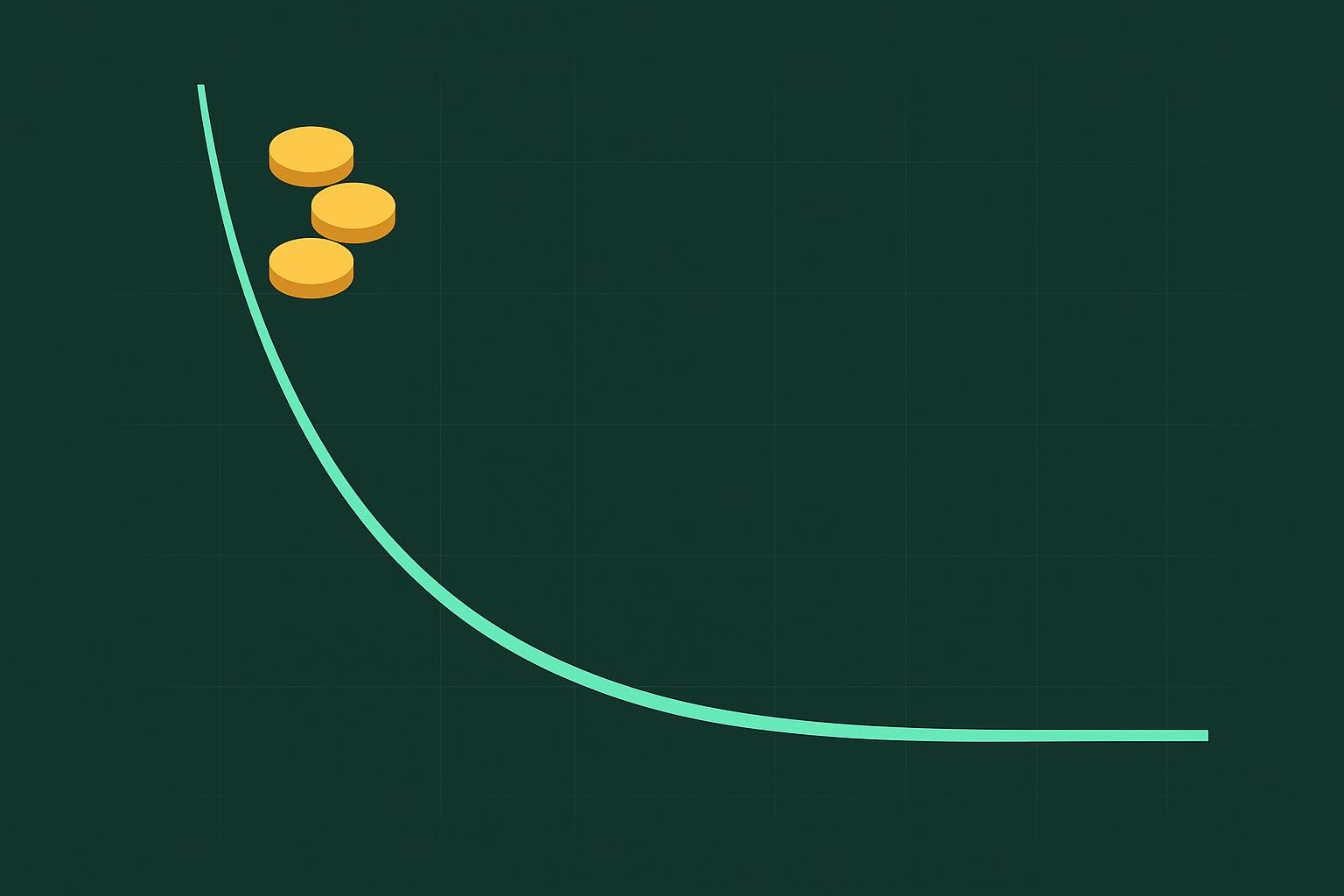
Your real blended Stripe rate by average ticket (2026)
Your real blended Stripe rate in 2026 is 2.9% plus $0.30 divided by your average ticket (US domestic online cards). Below about $20 the flat 30 cents dominates: an $8 ticket pays 6.65%, a $45 ticket 3.57%, a $220 ticket 3.04%. The biggest lever is raising your average ticket (annual billing, bundling, minimums) or moving large invoices to ACH at 0.8%, capped at $5.