Lovable Pricing in 2026: What 100 Credits Really Cost You
As of September 2026, Lovable costs $0 (Free, 5 build credits/day up to 30 a month) or runs on an eleven-rung credit ladder: Pro from $25/month for 100 credits up to $2,250 for 10,000, and Business from $50 for the same 100 up to $4,300 for 10,000. Business is exactly twice Pro per credit at every rung, so $50 a month buys 200 Pro credits or 100 Business credits. A credit buys a variable amount of work: 0.50 to 1.70 credits per action in Default Mode, or 1 credit per message in Plan Mode. Budget by credits-per-feature and pick your rung, not by the sticker.
Updated on September 19, 2026

On this page
As of July 2026, Lovable 
Correction, September 19, 2026. This teardown originally described Pro as a flat $25 a month for 100 credits and Business as a flat $50 a month for the same 100 credits, and concluded that "the plan that costs twice as much does not give you more capacity to build" and that "upgrading for more room to build does not help." Lovable's pricing page now publishes Pro and Business as eleven-rung credit ladders running from 100 credits up to 10,000, so moving up a rung is exactly how you buy more room to build. The $25 and $50 figures are the entry rungs, not the plan prices. The ladders and the corrected reasoning are below. Every other figure on this page was re-checked against Lovable's pricing page on September 19, 2026 and is unchanged.
What are Lovable's plans in July 2026?
Straight from Lovable's pricing page, re-checked September 19, 2026, billed monthly:
Scroll to see more
| Plan | Price / month | Monthly credits | What you are really paying for |
|---|---|---|---|
| Free | $0 | 5 build credits/day, up to 30/mo (plus 20 Cloud credits) | Trying it out, no card, workspace-private projects, 5 lovable.app domains |
| Pro | From $25 | 100 to 10,000, you pick the rung | Custom domains, credit rollovers, on-demand top-ups, remove the Lovable badge, email support |
| Business | From $50 | 100 to 10,000, you pick the rung | Team workspace, SSO, role-based access, security center, priority support |
| Enterprise | Volume-based | Volume-based | SCIM, audit logs, custom connectors, dedicated support |
Annual billing gives you two months free (roughly 17 percent off) on Pro and Business. Students can get up to 50 percent off Pro.
Note the Free grant is a daily faucet, not a monthly bucket: 5 build credits a day that do not roll over, capped at 30 a month. A heavy Saturday build session stalls after credit number 5.
The credit ladder is the actual price list
The $25 and $50 stickers are the first rung of a dropdown on each paid card. Lovable publishes eleven rungs per plan, and the same credit count always costs exactly twice as much on Business as on Pro:
Scroll to see more
| Monthly credits | Pro | Business | Pro per credit | Business per credit |
|---|---|---|---|---|
| 100 | $25 | $50 | $0.250 | $0.500 |
| 200 | $50 | $100 | $0.250 | $0.500 |
| 400 | $100 | $200 | $0.250 | $0.500 |
| 800 | $200 | $400 | $0.250 | $0.500 |
| 1,200 | $294 (save 2%) | $588 (save 2%) | $0.245 | $0.490 |
| 2,000 | $480 (save 4%) | $960 (save 4%) | $0.240 | $0.480 |
| 3,000 | $705 (save 6%) | $1,410 (save 6%) | $0.235 | $0.470 |
| 4,000 | $920 (save 8%) | $1,840 (save 8%) | $0.230 | $0.460 |
| 5,000 | $1,125 (save 10%) | $2,250 (save 10%) | $0.225 | $0.450 |
| 7,500 | $1,688 (save 10%) | $3,300 (save 12%) | $0.225 | $0.440 |
| 10,000 | $2,250 (save 10%) | $4,300 (save 14%) | $0.225 | $0.430 |
Two things fall out of that table. The volume discount does not start until 1,200 credits, so the first four rungs are a flat $0.25 per credit on Pro and $0.50 on Business. And Business discounts deeper at the top: its 10,000-credit rung is 14 percent off list against Pro's 10 percent, so the Business premium narrows from exactly 2.00x at the bottom to 1.91x at 10,000 credits. It never disappears.
What a Lovable credit actually buys
This is where the sticker price stops being useful. A credit is spent per action, and the amount varies. Per Lovable's credits and usage docs (July 2026):
- Default Mode: credits scale with task complexity. A simple change costs about 0.50 credits; a complex feature runs up to 1.70 credits.
- Plan Mode: a flat 1 credit per message, which is the predictable option when you want to scope work before building.
So 100 credits is not 100 features and not 100 messages. In Default Mode at a blended ~1.2 credits per action, 100 credits is roughly 83 actions. In Plan Mode it is exactly 100 messages. Two people on the same $25 plan can get very different mileage depending on how they work. This is the same trap that makes any usage-metered tool hard to budget, which is why we keep a running true cost of AI app builders breakdown across the field.
Two more mechanics that move real money:
- Credits expire. Monthly plan credits expire two months after they are issued. Annual plan credits expire one month after the annual period ends. Top-up credits last twelve months from purchase.
- Nothing is refundable, and when you run out mid-build you buy on-demand top-ups to keep going. That is the "my credits ran out and my bill jumped" complaint you see on Reddit in one sentence: the plan credit is a budget, not a ceiling. Metered AI cost behaves the same way one layer down, which is exactly what our OpenAI API pricing teardown walks through.
The effective cost per credit
Divide the price by the credits at the entry rung and the gap is blunt:
Scroll to see more
| Plan | Price | Credits | Effective cost per credit |
|---|---|---|---|
| Free | $0 | up to 30/mo | $0, but throughput-capped at 5/day |
| Pro, entry rung | $25 | 100 | $0.25 per credit |
| Business, entry rung | $50 | 100 | $0.50 per credit |
Read that last column again. At the entry rung Pro buys credits at $0.25 and Business buys the same count at $0.50, and that 2x multiple holds at every rung until the volume discounts diverge above 5,000 credits. Lovable's own FAQ adds one qualification worth knowing: it says credits "are not necessarily equal in value across different plans", and that because credits are priced higher on Business, a team switching from Pro to Business sees its credit usage for running apps and for in-app AI features go down. So the 2x is what you pay per credit, not a claim that every unit of work costs the same number of credits on both plans.
The line the plan tables hide: Business costs you half your credits
Compare the two plans at a fixed budget rather than at a fixed credit count. For $50 a month you can buy 200 Pro credits or 100 Business credits. For $200 a month you can buy 800 Pro credits or 400 Business credits. The governance package on Business is not priced at $25 a month. It is priced at half your credits, at whatever spend you pick.
That is the number to put in front of whoever approves the upgrade. Business buys team workspace, SSO, role-based access, a security center and priority support, and those are real and worth it for a company that needs them. But if you are eyeing Business because you keep running out of credits on Pro, moving up the Pro ladder is the cheaper fix: 200 Pro credits cost the same $50 as the Business plan you were about to buy for 100.
Three worked 30-day bills
These are rate-math on stated assumptions using Lovable's own published credit ranges, not quotes from Lovable and not benchmarks.
1. Hobby builder, Free plan. Ships a small landing page plus a contact form, iterating in Plan Mode at 1 credit per message. About 25 messages across the month keeps you under the 30-credit grant. Bill: $0. The catch is throughput: the 5-per-day faucet means a burst weekend caps at 10 credits, so an ambitious build day gets rationed, not billed.
2. Solo founder, Pro plan. Builds a real MVP with genuine iteration. Assume roughly 130 credits of Default-Mode work across the month (a mix of 0.50 tweaks and 1.70 features, plus a few debugging loops that eat credits without shipping anything). The 100 credits on the entry rung cover the first ~77 percent. Two ways to close the gap: a top-up on the $25 rung, or the 200-credit rung at $50 a month. Bill: $25 plus a top-up, or $50 flat with 70 credits of headroom. The lesson: iteration depth drives this bill, not how many apps you build. A stubborn bug loop is a line item.
3. Small team, Business plan. Four people sharing one workspace, needing SSO. Say the team burns 250 credits in a busy month. The entry rung covers 100, so the real choice is the 400-credit Business rung at $200 a month, or the 200-credit rung at $100 plus 50 credits of top-ups. The same 400 credits on Pro cost $100. Bill: $100 to $200, against $100 for the identical credits without the governance. A capacity-hungry team on Business pays for scale twice: once in the doubled per-credit rate, again in whatever overage the rung does not cover.
Where credit pricing bites, and when a flat subscription wins
Credit metering is honest and flexible, but the cost scales with how much you iterate, and heavy debugging or big refactors can spike a month with nothing shipped to show for it. Unused credits also expire, so you are on a use-it-or-lose-it clock. The model has drawn real outside scrutiny as Lovable scaled; the billing team at Lago published a sharp analysis of whether Lovable is nailing its pricing that is worth reading alongside the plan page.
To be clear about where Lovable is genuinely strong, because this is a tradeoff and not a verdict: the Free tier is actually usable without a card, it is backed by a real Supabase PostgreSQL database you can query and take with you, and it has one of the largest builder communities and template libraries in 2026. If you want SQL and a big ecosystem, that is a real reason to pick it.
The alternative pricing philosophy is a flat per-project subscription with a fixed monthly credit allotment, where the sticker is the ceiling. Bolt.new 


The point is not to switch. It is to match the pricing model to your build pattern. Bursty, heavy-iteration work punishes credit metering and rewards a flat sticker. Light, steady use is exactly what a free tier or a $25 credit plan is built for. If it is build quality rather than price you are weighing, community-run leaderboards like BuilderProof score these tools head-to-head on reproducible criteria.
How to keep your Lovable bill down
- Scope in Plan Mode, execute in Default Mode. Plan Mode's flat 1 credit per message is predictable; use it to lock the spec before you spend variable Default-Mode credits building it.
- Batch changes into one message. Every Default-Mode action costs 0.50 to 1.70 credits, so ten tiny follow-up prompts cost far more than one well-scoped request.
- Right-size the rung before you right-size the plan. Do not buy Business for capacity: at every rung it is exactly twice the price per credit. If you are short on credits, move up the Pro ladder. Move to Business only when you need SSO and access control.
- Prefer top-ups to a plan jump when you are short on credits, not features. Top-ups last twelve months; monthly plan credits expire in two. If you overrun occasionally, a top-up is cheaper than a permanent tier upgrade.
- Go annual only if you will use it. Two months free is real, but annual credits expire one month after the period, so banking a year of credits to spend in December does not work.
Math check: at every rung Business costs exactly twice Pro per credit, so $50 a month buys 200 Pro credits or 100 Business credits. Governance is priced in credits forgone, not in dollars. Budget by credits-per-feature and pick your rung, not by the $25 sticker.
Written by
Diego AguirreFrequently asked questions
How much does Lovable cost in 2026?
As of September 2026, Lovable is $0 on Free, from $25/month for Pro and from $50/month for Business, with volume-based Enterprise pricing. Those two figures are the entry rungs of an eleven-step credit ladder that runs from 100 credits up to 10,000 on each plan, topping out at $2,250/month on Pro and $4,300/month on Business. Annual billing gives two months free.
What is a Lovable credit and what does it buy?
A credit is spent per action and the amount varies. In Default Mode a simple change costs about 0.50 credits and a complex feature up to 1.70; in Plan Mode it is a flat 1 credit per message. The Free tier grants 5 build credits per day, up to 30 a month.
Why is Business twice the price of Pro at the same credit count?
Business is a governance upgrade, and it is priced in credits rather than in dollars. Every rung of the Business ladder costs exactly twice the Pro rung with the same credit count, so $50 a month buys either 200 Pro credits or 100 Business credits. The premium buys team workspace, SSO, role-based access, a security center and priority support. If you are short on credits rather than on governance, move up the Pro ladder instead: it is the cheaper half of the same trade.
Do Lovable credits expire?
Yes. Monthly plan credits expire two months after they are issued, annual plan credits expire one month after the annual period ends, and top-up credits last twelve months from purchase. Credits are not refundable.
Is Lovable cheaper than Bolt or v0?
It depends on your iteration pattern. Lovable, Bolt.new, and v0 all meter by credits or tokens, so cost scales with usage and heavy iteration raises the bill. Flat per-project builders bill a fixed sticker instead, which suits bursty, high-iteration work.
How do I lower my Lovable bill?
Scope in Plan Mode before executing in Default Mode, batch changes into one message instead of many small prompts, right-size your plan (do not buy Business for capacity), and use top-ups rather than a permanent tier jump when you are only occasionally short on credits.
Does Lovable have a free plan?
Yes. The Free plan is $0 with no credit card, granting 5 build credits per day up to 30 a month plus 20 Cloud credits, workspace-private projects, and 5 lovable.app domains. It is throughput-capped rather than billed.
Related reading
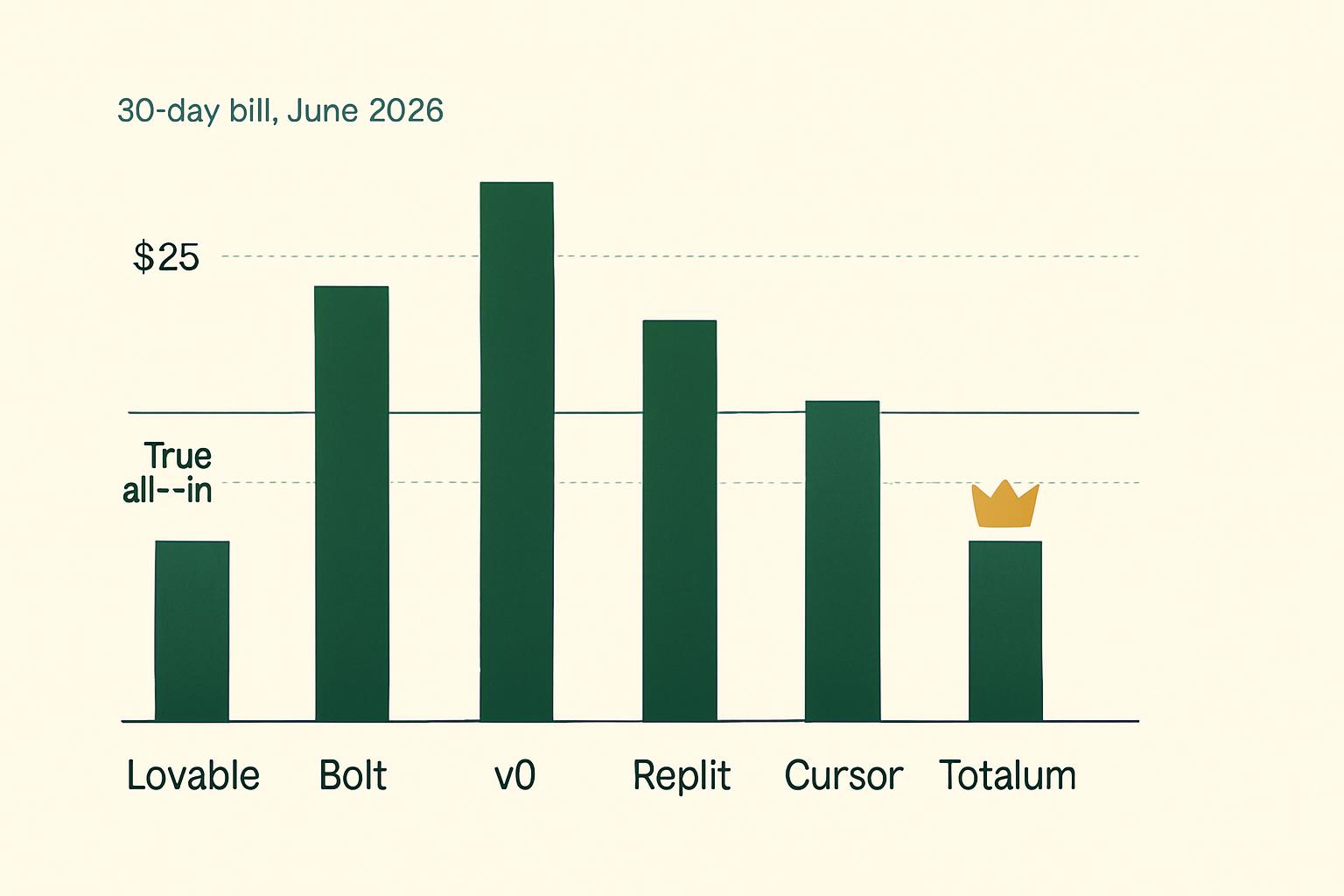
AI app builder cost in 2026: 6 platforms billed for 30 days
The sticker on Lovable, Bolt, v0, Replit, Cursor, and Totalum is between $20 and $79. The 30-day bill on a real reference workload is $69 to $270. Here is what each pricing page leaves off, with the math.


Grafana Cloud Pricing (2026): How One Label Turns a $0 Bill Into $2,089
A worked-bill teardown of Grafana Cloud's 2026 pricing: how the active-series meter works, why one high-cardinality label can turn a $0 free-tier bill into $2,089 a month, and the one-lever fix.