Render Pricing in 2026: What a Real Monthly Bill Actually Looks Like
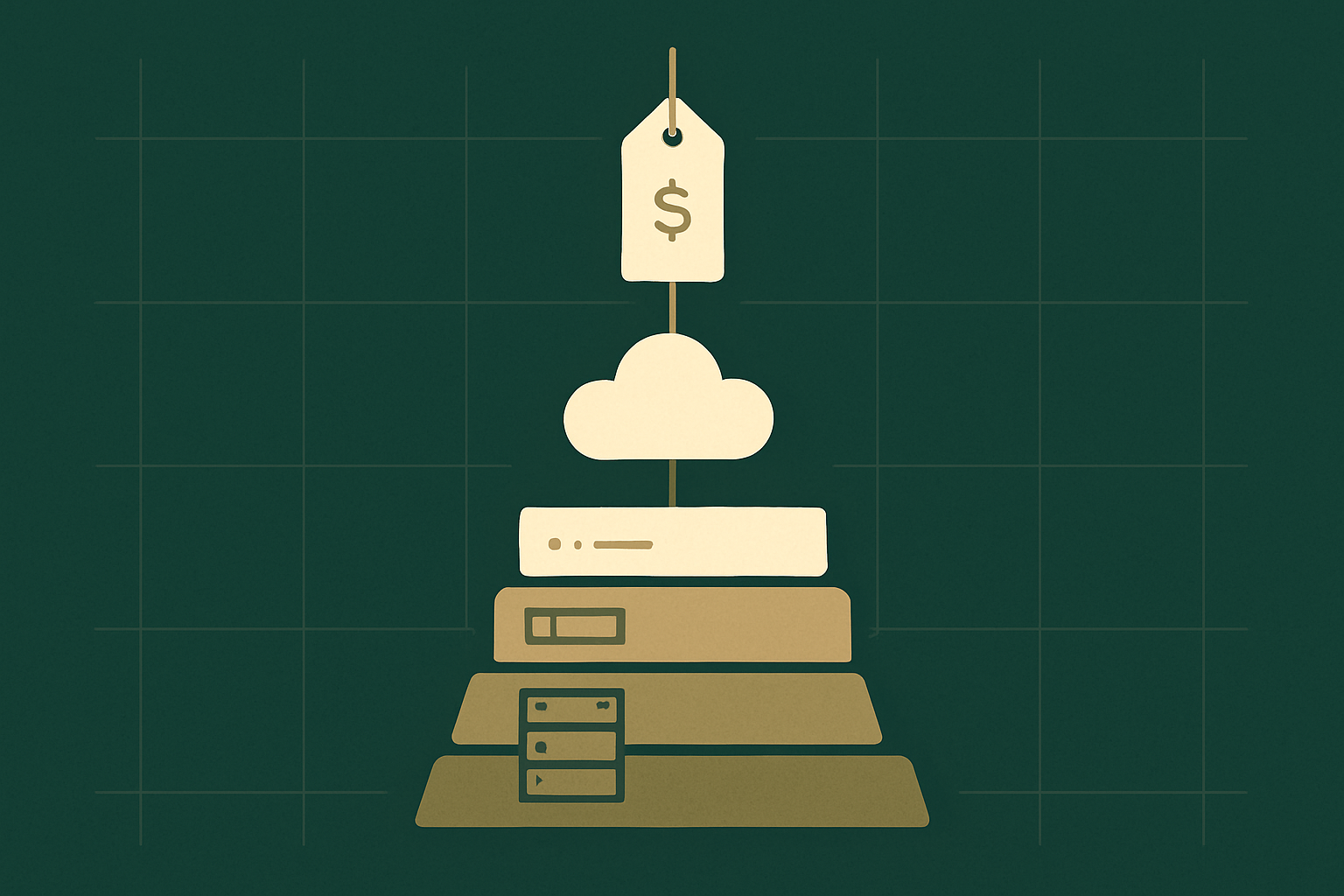
Render's advertised prices hide the real bill. In 2026 your cost is three stacked layers: a workspace plan, per-service compute, and metered usage. A solo production app starts near $13/mo (not $7), a small team app around $115/mo. Here is the arithmetic, with three worked 30-day bills.
Updated on August 22, 2026
On this page
Quick answer (2026): Render's advertised prices hide the real bill. Your monthly cost is three stacked layers, not one: a workspace plan (Hobby $0, Pro $25/mo, Scale $499/mo), per-service compute (Free $0, Starter $7/mo, Standard $25/mo, up to Pro Ultra $450/mo), and metered usage (bandwidth at $0.15/GB past your included tier, plus databases and caching). A solo production app realistically starts near $13/mo, not the "$7" sticker, because you almost always need a database too. A small team app lands around $115/mo before traffic. All figures below are from Render's pricing page (Render, 2026).
Render bills you for three things, not one
Most "Render is $7 a month" claims quote a single compute instance and stop there. Render's own billing FAQ is clearer than its marketing: you pay for a workspace plan (a flat subscription), metered features like bandwidth (usage-based), and compute for each service you run (usage-based, prorated to the second). Miss any one of those three and your mental math is wrong.
Here is how the three platforms people most often compare bill at the plan level:
Scroll to see more
| Platform | Flat plan floor | Compute model |
|---|---|---|
 Render Render | $0 Hobby / $25 Pro per mo | Per-service instance, prorated by the second |
 Railway Railway | Usage-based, $5/mo minimum | Pure usage (vCPU + RAM per minute) |
 Fly.io Fly.io | Pay-as-you-go | Per-machine, per-second |
Railway and Fly.io figures are from railway.com/pricing and fly.io/pricing (2026). We break Railway's usage billing down separately in railway-pricing-2026.
Layer 1: the workspace plan
The workspace plan is a flat subscription that sits under everything you run. It buys team features and included allowances, not app capacity.
Scroll to see more
| Workspace | Price | What you get |
|---|---|---|
| Hobby | $0/mo | 1 seat, up to 25 services, 5 GB bandwidth, 500 build minutes |
| Pro | $25/mo | Unlimited seats and services, 25 GB bandwidth, horizontal autoscaling, full-stack previews |
| Scale | $499/mo | Multiple workspaces, 1 TB bandwidth, SAML SSO, HIPAA-ready |
| Enterprise | Custom | Uptime SLAs, dedicated support |
The single most common overpayment is jumping to Pro too early. If you are one developer shipping one app, Hobby ($0) plus paid compute is a complete, production-capable setup. Pro's $25 buys unlimited seats, autoscaling, and more included bandwidth. It does not make your app run any better.
Worth knowing: if a Pro or Scale workspace has no services and no activity in a given month, Render waives that month's subscription fee. That matters if you spin environments up and down for seasonal or client work.
Layer 2: compute (the number people quote)
Compute is billed per service, prorated to the second. This is the "$7" everyone repeats. It is real, but it is one service.
Scroll to see more
| Web service instance | Price | RAM | CPU |
|---|---|---|---|
| Free | $0/mo | 512 MB | 0.1 |
| Starter | $7/mo | 512 MB | 0.5 |
| Standard | $25/mo | 2 GB | 1 |
| Pro | $85/mo | 4 GB | 2 |
| Pro Plus | $175/mo | 8 GB | 4 |
| Pro Max | $225/mo | 16 GB | 4 |
| Pro Ultra | $450/mo | 32 GB | 8 |
The Free instance is genuinely $0, with one catch we cover below. Because billing is prorated to the second, short-lived work (Cron Jobs, preview environments, a background worker that runs 20 minutes a day) costs cents, not a monthly plan.
Layer 3: the add-ons that quietly stack
This is the layer that turns "$7" into a real bill. Every one of these is a separate line item.
- Render Postgres: Free $0 (256 MB, 30-day limit), then Basic-256mb $6/mo, Basic-1gb $19/mo, Basic-4gb $75/mo. Expandable storage is $0.30/GB.
- Render Key Value (Redis-compatible): Free $0 (25 MB), Starter $10/mo (256 MB), Standard $32/mo (1 GB), Pro $135/mo (5 GB).
- Bandwidth: included in your workspace plan (5 GB Hobby, 25 GB Pro, 1 TB Scale), then $0.15/GB.
- Persistent disks: $0.25/GB per month.
- Build pipeline: 500 minutes/mo on Hobby, then $5 per 1,000 minutes. The Performance pipeline runs on larger instances at $25 per 1,000 minutes.
- Custom domains: 2 included on Hobby, then $0.25/domain per month.
- Dedicated IPs: $100/mo per IP set, if you need static outbound addresses.
The pattern to internalize: your first surprise line item is almost never the web service. It is the database.
Three real 30-day bills
A. The hobby prototype: $0, with two asterisks
Hobby workspace ($0) plus a Free web service ($0) plus Free Postgres ($0). Real cost: $0. The asterisks: the Free web service spins down after inactivity, so the next visitor waits through a cold start, and Free Postgres is capped at 30 days before it is removed. Perfect for a demo. Not something a paying user should depend on.
B. The solo production app: $13 to $54
You do not need the Pro workspace here. Stay on Hobby ($0) and pay only for compute:
- Starter web service ($7) + Basic-256mb Postgres ($6) = $13/mo. This is the real floor, not $7, because a web app almost always needs a database.
- Add a small Key Value cache (Starter, $10) and you are at $23.
- Outgrow 512 MB and move the web service to Standard ($25) and Postgres to Basic-1gb ($19), and you land near $54/mo, still on the $0 workspace, with 5 GB of bandwidth included.
C. The small team app: $115 and up
Now you want teammates, so the Pro workspace ($25) earns its keep with unlimited seats, autoscaling, and 25 GB of bandwidth. A representative bill:
- Pro workspace: $25
- Standard web service: $25
- Pro-4gb Postgres: $55
- Key Value Starter: $10
That is $115/mo before traffic. Push 40 GB of bandwidth in a month and you add 15 GB over the included 25 GB at $0.15/GB, so about $2.25 more. Add a background worker (Starter, $7) or a dedicated IP ($100) and the number moves quickly.
Five ways to keep the bill down
- Stay on Hobby until you need a team. The $25 Pro fee buys seats, autoscaling, and bandwidth, not app performance. One developer, one app rarely needs it.
- Use the workspace-fee waiver. A Pro or Scale workspace with no services and no activity in a month is not billed for that month. Good for seasonal and client environments.
- Right-size by the second. Because compute is prorated to the second, Cron Jobs and preview environments that run briefly cost cents. Do not put periodic work on a full-time instance.
- Get off Free Postgres before day 30. Move real data to Basic-256mb ($6) before the 30-day clock removes the database.
- Watch bandwidth at $0.15/GB. It is cheaper than most egress meters, but a media-heavy app past its included tier still adds up. Lean on the zero-config CDN for static assets and keep large files in object storage, which is roughly an order of magnitude cheaper per GB. We worked that math in cloudflare-r2-pricing-2026.
The trap nobody prints on the pricing page
Two Render defaults quietly cost people money or data. Free web services spin down on inactivity, which is fine for a side project and a problem the moment a real user hits a cold start. And Free Postgres has a hard 30-day life, after which the database is gone. Neither is hidden, exactly, but neither is loud. Read the fine print on the Free tier before you build anything a customer will touch.
Math check: the "$7 Starter" is only a third of a real solo bill. Add the cheapest usable database (Basic-256mb, $6) and you are at $13/mo before your first visitor, which is still the cheapest honest floor among the three platforms here.
Written by
Camille ForsterFrequently asked questions
How much does Render actually cost per month in 2026?
It depends on three stacked layers: a workspace plan (Hobby $0, Pro $25/mo, Scale $499/mo), per-service compute (Free $0, Starter $7/mo, Standard $25/mo, up to Pro Ultra $450/mo), and metered usage like bandwidth at $0.15/GB. A solo production app realistically starts near $13/mo and a small team app around $115/mo before traffic (Render, 2026).
Is Render really free?
Yes, Render has genuine $0 tiers: a Free web service, Free Postgres, and Free Key Value. But Free web services spin down on inactivity (cold starts) and Free Postgres is capped at 30 days before the database is removed. The free tier is built for demos and prototypes, not production apps a customer depends on.
Do I need the $25 Pro workspace plan?
Not to run one app. A single developer can stay on the $0 Hobby workspace and pay only for compute. The Pro plan's $25/mo buys unlimited seats, horizontal autoscaling, full-stack previews, and 25 GB of included bandwidth. It adds team features and allowances, not app performance.
What is the cheapest way to run a real production app on Render?
Stay on the Hobby workspace ($0) and pay for a Starter web service ($7/mo) plus the smallest usable database, Basic-256mb Postgres ($6/mo). That is about $13/mo, which is the honest floor. The commonly quoted $7 leaves out the database that nearly every app needs.
How does Render bill for bandwidth in 2026?
Each workspace plan includes a bandwidth allowance (5 GB on Hobby, 25 GB on Pro, 1 TB on Scale). Beyond the included amount, bandwidth is $0.15/GB. That is cheaper than many egress meters, but a media-heavy app past its included tier can still add a meaningful line item.
How is Render compute billing calculated?
Compute is billed per service and prorated to the second. If you run a paid instance for 24 hours and turn it off, you pay for 24 hours. Services that start and stop automatically, like Cron Jobs and Workflows, are billed only while actively running, so short-lived work costs cents rather than a full monthly plan.
Related reading

Railway Pricing in 2026: What You Actually Pay
Railway pricing in 2026 is usage-based: you pay $20 per vCPU and $10 per GB of RAM per month, billed by the second, plus $0.05 per GB of egress and $0.15 per GB of volume storage. Hobby is $5 a month with $5 of usage included; Pro is $20 a month per workspace, not per seat, with unlimited seats and $20 of usage included. Railway also runs a permanent Free plan at $0 a month with $1 of usage credits alongside the 30-day $5 trial, so a small always-on app runs about $5 to $22 a month and a modest production stack near $70. Those are container rates: sandboxes and cloud agents run on Railway's VM primitive at $50 per vCPU and $50 per GB of RAM per month.

Cloudflare R2 Pricing in 2026: What You Actually Pay
Cloudflare R2 pricing in 2026 charges for storage and operations but never for egress: Standard storage is $0.015/GB-month, Class A writes $4.50/million, Class B reads $0.36/million, with a permanent free tier of 10 GB plus 1M/10M operations. Free egress is the whole pitch, and it moves your bill onto operations, not gigabytes. Below: three real 30-day bills versus Amazon S3 and Backblaze B2, and the Infrequent Access trap that doubles a write-heavy bill.