Courier Pricing in 2026: What $0.005 Per Send Really Costs
Courier bills $0.005 per notification sent, first 10,000 free, and the meter counts notifications, not channels. Three worked 30-day bills and the one lever that cuts them.
Updated on October 1, 2026

On this page
Quick answer (2026): Courier 
How does Courier bill in 2026?
Courier keeps the pricing page short. Two numbers do all the work (Courier pricing, 2026):
- Developer: free, up to 10,000 sends a month.
- Pay-as-you-go: $0.005 per send after that.
Enterprise adds volume pricing and custom terms, but the public meter is a single per-send rate. Courier states it plainly: pricing is based on notifications sent, not team size or channels. There are no per-seat charges and no per-channel add-on fees. Add ten teammates or a fourth delivery channel and the invoice does not move. Only the send count does.
What does $0.005 per send mean in real money?
Per-send rates hide their scale. Convert the number once and keep it:
- $0.005 per send
- $5.00 per 1,000 sends
- $5,000 per 1,000,000 sends
A send sounds free until you multiply it by an active user base and a daily cadence. Ten thousand free sends covers a side project or an early launch. It does not cover a live product that pings users more than once a day.
Why are channels free but frequency the trap?
This is the part worth internalizing. Because Courier meters notifications and not channels, the usual usage-billing multiplier is not where you would expect it.
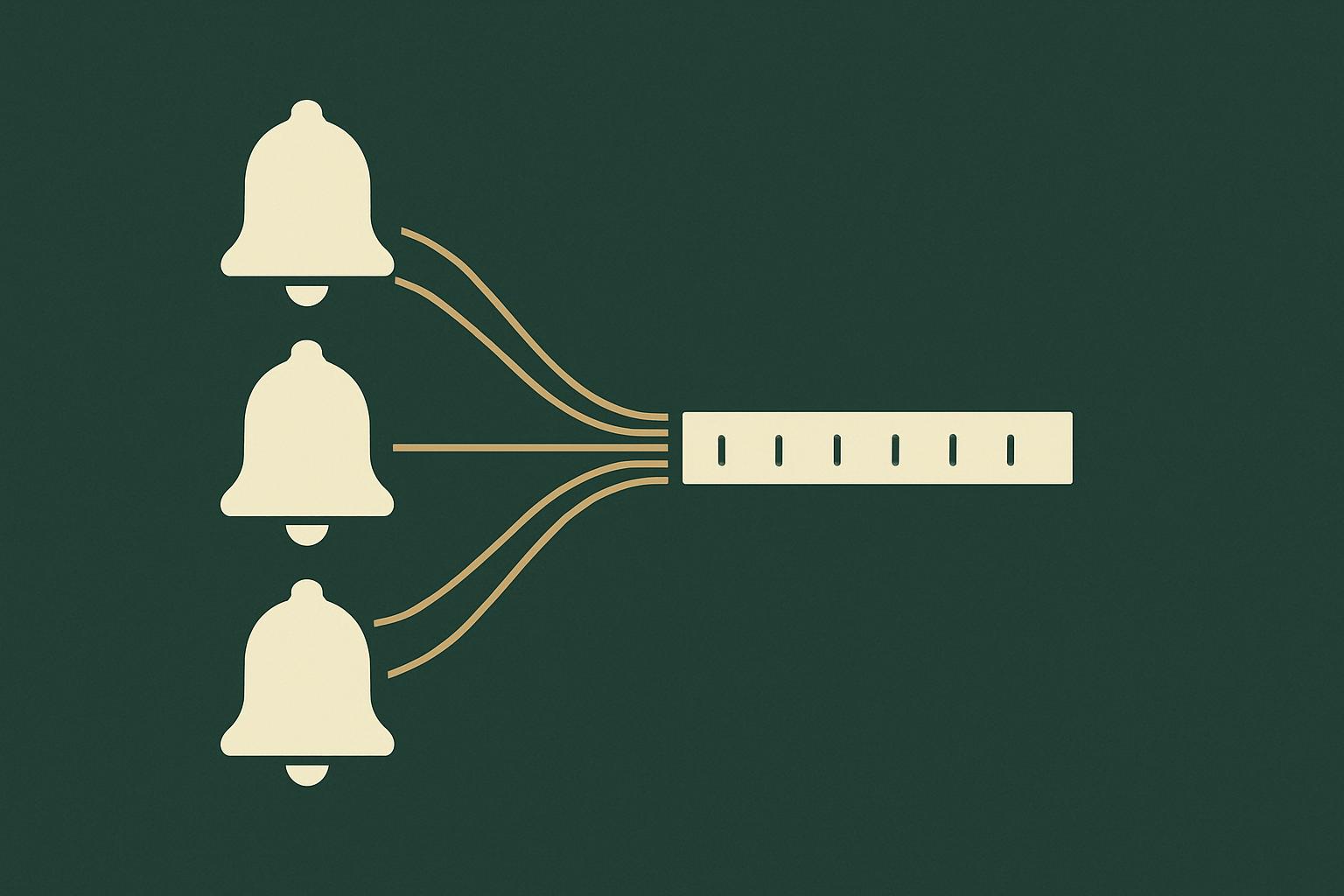
Say you route one notification to a user across three channels: email, SMS, and push. On a per-message or per-channel meter, that is three billable units. On Courier it is one send. The channel fan-out that inflates most notification bills does not exist here.
Run the arithmetic. An app fires 1,800,000 notifications in a month, each delivered on three channels:
- On Courier: 1,800,000 sends, because channels do not multiply the meter. Orchestration cost is about $8,950.
- On a hypothetical per-channel meter at the same $0.005 rate: 5,400,000 units, or about $27,000.
The meter is on your side for channels. The cost lives somewhere else: how often you notify, and how many people you notify. Frequency times audience is the entire bill.
What do three 30-day Courier bills look like?
Same $0.005 rate, three very different invoices. The first 10,000 sends are free in each case.
Scroll to see more
| Cohort | Monthly sends | Billable (minus 10,000) | 30-day bill |
|---|---|---|---|
| Disciplined SaaS: 5,000 users, ~1 transactional notice/user/week | 21,500 | 11,500 | $57.50 |
| Notification-happy app: 20,000 DAU x 3/day | 1,800,000 | 1,790,000 | $8,950.00 |
| Same app after digesting to 1/day | 600,000 | 590,000 | $2,950.00 |
The disciplined product barely registers. The notification-happy product pays almost nine thousand dollars a month, and not one dollar of that came from adding channels. It came from cadence.
What is the one lever that cut the bill $6,000?
Batching. The notification-happy app in the table sent three separate nudges per user per day. Collapse those into a single daily digest and the send count drops from 1,800,000 to 600,000. The bill falls from $8,950 to $2,950. That is a $6,000 monthly cut with the same audience, the same channels, and arguably a better user experience.
The lever is always the same on a per-notification meter: reduce the number of distinct notifications, not the number of channels. Digest low-urgency events. Collapse retries and duplicates. Honor mute preferences so you are not paying to send messages people already silenced. None of that is a code rewrite. It is a notification-strategy decision that happens to also be the cheapest one.
What does the free Developer plan actually cover?
The Developer plan is capped at 10,000 sends a month, and it does not carry overage. You do not silently accrue a bill on the free tier; you reach the ceiling and move to pay-as-you-go to keep sending. That is friendlier than a metered free tier that quietly bills a viral spike, but it also makes the planning number simple: budget for paid the month you expect to cross 10,000 sends, and budget on total API calls rather than production traffic. Courier counts a send as one notification submitted to its API and states that sends made with a test API key count against the same allowance (Courier pricing FAQ, 2026). A staging environment firing a few thousand notifications a month eats the free tier at exactly the same rate as production. At 30,000 sends that is 20,000 billable at $0.005, or $100. At 100,000 sends it is $450. There is no per-seat charge stacked on top.
Correction, October 1, 2026: this page previously stated that Courier's pricing page did not itemize edge cases such as test messages, and advised confirming them with Courier directly. Courier's pricing FAQ answers it directly: a send is one notification submitted to the Courier API, sends made with a test API key count, and a notification routed to several channels counts as one send rather than one per channel. The $0.005 rate, the 10,000 free monthly allowance and every bill in this teardown are unchanged.
What are you actually paying for, and when should you self-host?
Here is the honest framing. Courier is an orchestration layer: routing, templates, preferences, batching, and cross-channel logic. The $0.005 per send buys that orchestration. It does not buy delivery. You still pay SendGrid or your email provider for the actual email, and Twilio or your SMS provider for the actual text. At 1,800,000 sends, the $8,950 is the orchestration bill. Delivery is separate and on top.
That reframes build versus buy. If your routing is simple and orchestration cost dominates, an open-source layer such as Novu 

The rule of thumb: below a few hundred thousand sends a month, managed orchestration is cheaper than the engineering time to replace it. Above that, and with simple routing, the per-send fee starts to look like rent on code you could own.
Math check: Courier's meter is notifications, not channels. Three channels on one notification is still one send, so the multiplier that matters is frequency times audience. Cut 3 notifications per day to 1 daily digest for 20,000 users and the bill goes from $8,950 to $2,950, a 67 percent cut with the same reach.
Written by
Camille ForsterFrequently asked questions
How much does Courier cost in 2026?
Courier's Developer plan is free for up to 10,000 notification sends a month. Beyond that it is pay-as-you-go at $0.005 per send, and Enterprise adds custom volume pricing. Figures are from Courier's pricing page, 2026.
What counts as a send in Courier?
A send is one notification submitted to the Courier API. Courier states pricing is based on notifications sent, not channels or team size, so a single notification routed to multiple channels bills as one send. Courier states that sends made with a test API key count against the same allowance, so staging traffic consumes the free tier at the same rate as production.
Does Courier charge per channel?
No. Pricing is based on notifications sent, not channels. Adding email, SMS, or push delivery to a notification does not multiply the meter, so the cost driver is how often you notify, not how many channels you use.
Does Courier charge per seat?
No. There are no per-seat fees. Adding teammates does not change the bill; only send volume does.
Is Courier's free tier really free?
Yes, up to 10,000 sends per month on the Developer plan, with no overage on that tier. To send beyond 10,000 you move to pay-as-you-go at $0.005 per send.
How do I lower a Courier bill?
Reduce the number of distinct notifications, not the channels. Batch low-urgency events into digests, collapse duplicate and retry notifications, and honor mute preferences. Because the meter is per notification, cutting cadence is the only lever that moves the bill.
Is the per-send fee my whole notification cost?
No. Courier is an orchestration layer, so you still pay your email and SMS providers for actual delivery separately. The $0.005 per send is on top of those delivery costs.
Related reading
Knock Pricing in 2026: What Notification Infra Really Costs
As of July 2026, Knock's notification API charges per message, where a message is one delivery to one user on one channel. The Starter plan is $250 per month for 50,000 messages, then $0.005 each. Because Knock meters per channel, a single notification sent to email, push, and in-app counts as three messages, so a 5,000-user app fanning three channels can run about $750 per month. The same alerts cost roughly $250 on Courier's per-notification meter and about $54 on Novu's per-run Pro plan. Match the meter to your channel fan-out before you pick a vendor.

Svix pricing in 2026: the real 30-day webhook bill (and why $490 is almost never a volume decision)
Svix bills webhooks on attempted messages, and in 2026 the Free, $20 Basic and $490 Professional plans all include the same 50,000 a month. A numbers-first teardown: three real 30-day bills, the 64 KiB chunking trap, why Free is a hard cap with no overage, and why the jump to $490 is about throughput, not volume.

Build vs buy: when DIY beats SaaS at scale
Build-vs-buy isn't a values debate, it's a breakeven date. SaaS wins early because it converts a big upfront build into a small monthly fee. DIY wins once your usage-based SaaS bill exceeds the fully-loaded cost of owning the code, typically around month 18 for infrastructure-style tools. This piece gives you the formula, a worked example, and the three traps that make teams build too early.