Knock Pricing in 2026: What Notification Infra Really Costs
As of July 2026, Knock's notification API charges per message, where a message is one delivery to one user on one channel. The Starter plan is $250 per month for 50,000 messages, then $0.005 each. Because Knock meters per channel, a single notification sent to email, push, and in-app counts as three messages, so a 5,000-user app fanning three channels can run about $750 per month. The same alerts cost roughly $250 on Courier's per-notification meter and about $54 on Novu's per-run Pro plan. Match the meter to your channel fan-out before you pick a vendor.
Updated on August 22, 2026
On this page
Notification pricing pages quote a sticker. The sticker is not the bill. On notification infrastructure, the bill is set by the meter: the unit each vendor counts. Pick the wrong meter for your channel mix and you pay three times over for the exact same alerts.
We priced three notification platforms head to head as of July 2026: 


What does Knock actually cost in 2026?
Here is Knock's public pricing as of July 2026, from its pricing page:
Scroll to see more
| Plan | Price | Included messages | Overage | Notes |
|---|---|---|---|---|
| Developer | $0 | 10,000 / mo | n/a | 500 guide active users, 500 AI agent credits |
| Starter | $250 / mo | 50,000 / mo | $0.005 / message | 2,500 guide active users, then $0.05 / user |
| Enterprise | Custom | Volume tiers | Custom | Annual-commit and volume discounts |
The headline number is clean: $250 per month for 50,000 messages, then half a cent each. The problem is the word message.
The hidden meter: Knock bills per channel, not per notification
Knock defines a message as "a single message delivered to a single user on a single channel." Read that again with your own product in mind.
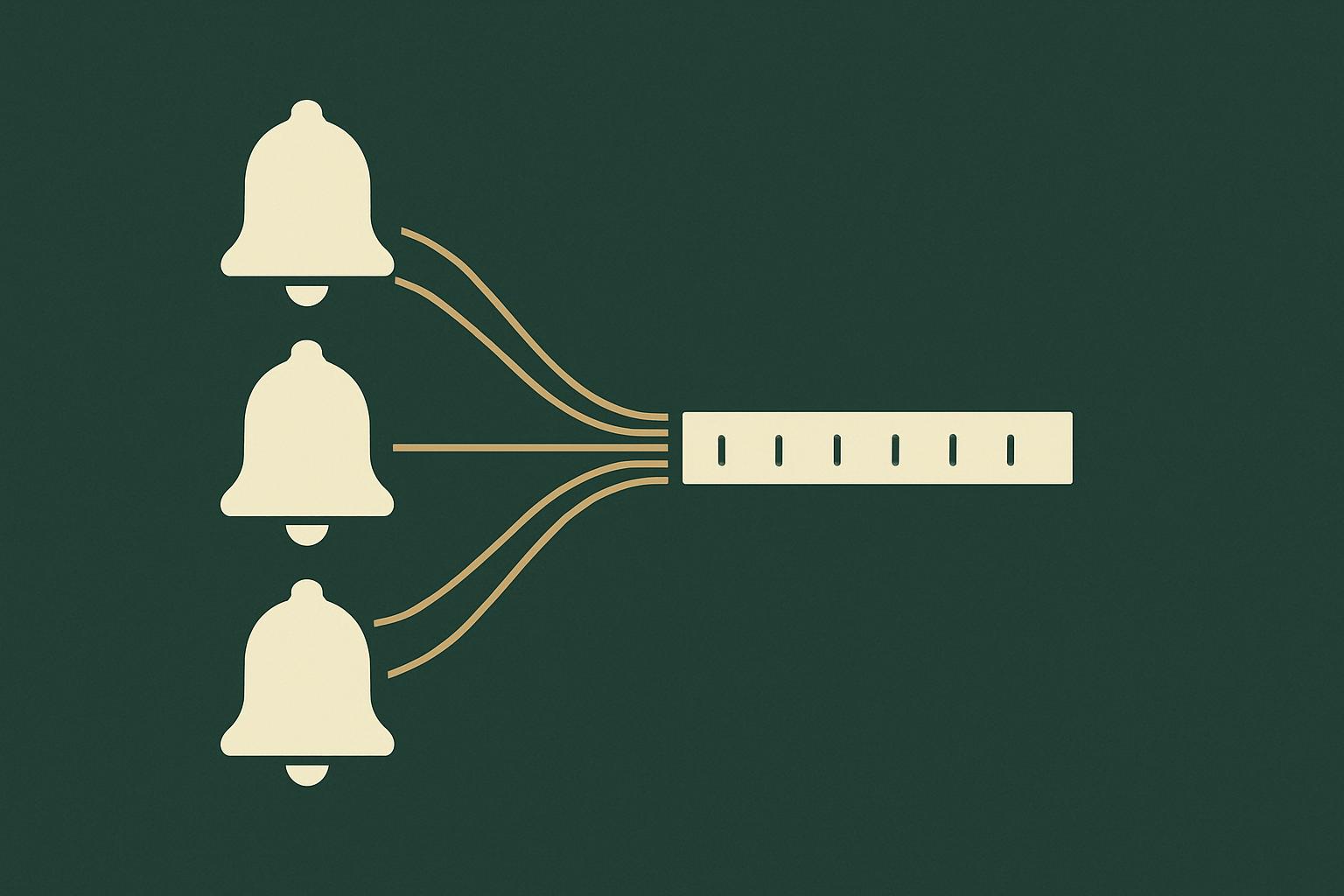
Say you send an order-shipped alert. It goes to email, to mobile push, and to the in-app feed. To you that is one notification. To Knock's meter it is three messages. Your bill scales with this formula:
> billable messages = users x notifications per user x channels per notification
The channel count is a multiplier most teams forget when they read the sticker. A per-notification mental model meets a per-channel-delivery meter, and the invoice arrives at triple what the pricing page implied.
A real 30-day bill: 5,000 users, 3 channels
Let us put a concrete workload through it. A mid-size SaaS with:
- 5,000 monthly active users
- 10 notifications per user per month
- 3 channels per notification: email, push, in-app feed
That is 50,000 notification events, and 150,000 channel deliveries.
On Knock, the meter counts channel deliveries, so the billable unit is 150,000 messages:
- Starter base: $250 for the first 50,000
- Overage: 100,000 x $0.005 = $500
- Knock total: $750 / month
None of that $750 is exotic. It is 150,000 half-cent deliveries with a base fee on top. The sticker said $250. The channel multiplier said $750.
Knock vs Courier vs Novu: same workload, three meters
Now run the identical 50,000 notifications through two competitors that count differently.
Courier bills per send and states plainly that "pricing is based on notifications sent, not team size or channels." Read at face value, a multi-channel notification is one send. So the billable unit is 50,000 sends, not 150,000:
- Business pay-as-you-go: 50,000 x $0.005 = $250 / month
Novu bills per workflow run. A run is one execution for one subscriber, and the channel steps live inside that single run. So the billable unit is again 50,000, not 150,000:
- Pro base: $30 for 30,000 runs
- Overage: 20,000 runs at $1.20 / 1,000 = $24
- Novu Pro total: $54 / month
Same alerts. Same users. Same three channels. Here is the scoreboard:
Scroll to see more
| Platform | Meter | Billable units | 30-day bill |
|---|---|---|---|
| Knock | per channel delivery | 150,000 messages | $750 |
| Courier | per notification | 50,000 sends | $250 |
| Novu (Pro) | per workflow run | 50,000 runs | $54 |
| Novu (self-host) | server + ops | n/a | ~$25 + your time |
That is a 14x spread, $54 to $750, driven almost entirely by which unit the vendor decided to count. One honest caveat before you screenshot this: confirm each vendor's exact multi-channel definition against your own routing, because a "send" or a "run" that quietly splits per channel would change these numbers. The pricing pages above are the source of truth as of July 2026.
The one lever: match the meter to your fan-out
The cheapest platform is not a fixed fact. It depends on your channel count.
- If you fan out to many channels, a per-notification meter (Courier) or a per-run meter (Novu) is dramatically cheaper, because neither multiplies by channels.
- If you send single-channel alerts, the meters converge and Knock's polish may win outright.
So the lever is not "pick the cheap vendor." It is "stop paying the channel multiplier where you do not need it." If 40 percent of your volume is a low-value in-app feed that duplicates the email, drop it or route it off the per-channel meter. On our workload, going from three channels to two takes Knock from 150,000 to 100,000 messages:
- $250 base + 50,000 x $0.005 = $500 / month
One config change, 33 percent off, no vendor migration required. The realtime in-app layer specifically is often the channel worth pulling in-house; we ran the same exercise on Pusher's connection meter and on Ably's per-delivery message meter, and the pattern repeats.
When Knock is worth $750 a month
This is not a cheapest-wins verdict. Knock's bill buys real things Novu self-host makes you build and operate: a managed in-app inbox, a hosted preference center, template management, delivery tracking, and a dashboard your non-engineers can use. Courier sits in the middle with a strong routing and template layer.
If notifications are a core product surface and engineering time is your scarce resource, paying per channel can be cheaper than staffing the equivalent internally. The honest failure mode is the reverse: a high-volume, low-value notification stream (activity feeds, digests, marketing nudges) sitting on a per-channel-delivery meter, quietly compounding.
Build vs buy: self-hosting Novu
Novu is open source. You can self-host it from its GitHub repo and pay only for the server plus your own operations time. At 50,000 runs that is a rounding error against $54 of managed Pro, but at 5 million runs the managed bill is real money and self-host starts to pay for itself.
The trade is the usual one, and it is the same trade we walked in build vs buy at scale: managed platforms sell you time, not just software. Self-hosting removes the per-run bill and hands you uptime, the inbox UI, and the preference center as your problem. Buy when notifications are adjacent to your core and you want the vendor to absorb the upkeep. Build when notification volume is core, high, and cost-sensitive enough to fund a maintainer.
Developers have flagged this cost cliff for years. As one Hacker News thread from November 2022 put it, "lot of products like Knock, novu, engagespot, courier, the pricing is on the upper side." The tools have improved since; the meter math has not changed.
Math check: on a per-channel-delivery meter your bill is users x notifications x channels. On a per-notification meter it drops the x channels. That one missing multiplier is the difference between $750 and $250 for the exact same alerts.
Sources
- Knock pricing, July 2026: https://knock.app/pricing
- Courier pricing, July 2026: https://www.courier.com/pricing
- Novu pricing, July 2026: https://novu.co/pricing/
- Novu open-source repository: https://github.com/novuhq/novu
- Hacker News, notification platform pricing discussion, November 2022: https://news.ycombinator.com/item?id=33622145
Written by
Camille ForsterFrequently asked questions
How much does Knock cost in 2026?
Knock has three tiers as of July 2026: a free Developer plan with 10,000 messages per month, a Starter plan at $250 per month covering 50,000 messages then $0.005 per message, and a custom Enterprise plan with volume and annual-commit discounts. The Starter plan also includes 2,500 guide active users at $0.05 per user beyond that, plus AI agent credits.
What counts as a message in Knock's pricing?
Knock defines a message as a single message delivered to a single user on a single channel. This is the detail that surprises people: one notification routed to email, push, and an in-app feed counts as three messages, not one. Your Knock bill scales with users times notifications times channels.
Is Knock more expensive than Courier or Novu?
For a multi-channel workload, usually yes, because Knock meters per channel delivery while Courier meters per notification sent and Novu meters per workflow run. On a 5,000-user app sending 10 notifications each across 3 channels, Knock runs about $750 per month, Courier about $250, and Novu Pro about $54. The gap comes almost entirely from the meter, not the sticker price.
Can I self-host a notification system for free?
Novu is open source and can be self-hosted at no license cost, so you pay only for the server and your own operations time. That removes the per-run bill entirely, which is attractive at high volume. The trade-off is that you now own uptime, the in-app inbox UI, and the preference center that a managed platform like Knock provides out of the box.
When is Knock worth the higher price?
Knock earns its bill when you want a managed in-app inbox, a hosted preference center, template management, and a polished dashboard without building any of it. If notifications are core product surface and engineering time is scarce, paying per channel can be cheaper than staffing the equivalent in-house. If notifications are high-volume and low-value, the per-channel meter works against you.
How do I lower a notification infrastructure bill?
Match the meter to your fan-out. If you are on a per-channel-delivery meter, drop or reroute your highest-volume, lowest-value channel. Moving a redundant in-app feed off a per-channel meter, or onto a self-hosted layer, cuts billable units immediately. On our example workload, dropping from three channels to two takes the Knock bill from $750 to $500, a 33 percent cut from one config change.
Related reading

Pusher Pricing in 2026: What You Actually Pay
Pusher Channels pricing in 2026 runs from a free Sandbox (100 concurrent connections, 200k messages/day) to $49 Startup, $99 Pro, $299 Business, and up to $1,199, billed on two meters: peak concurrent connections and messages per day. The trap is peak connections, because your plan must cover your highest simultaneous connection count, so a single 25-minute spike can push you from $99 to $499 for the whole month. This teardown works three real monthly bills, shows why the same app costs $99 on Pusher, about $278 on Ably, and about $630 on Liveblocks purely because each bills on a different meter, and does the self-host crossover math with Soketi.

Build vs buy: when DIY beats SaaS at scale
Build-vs-buy isn't a values debate, it's a breakeven date. SaaS wins early because it converts a big upfront build into a small monthly fee. DIY wins once your usage-based SaaS bill exceeds the fully-loaded cost of owning the code, typically around month 18 for infrastructure-style tools. This piece gives you the formula, a worked example, and the three traps that make teams build too early.

Sentry Pricing in 2026: What You Actually Pay
Sentry pricing in 2026 is event-based: a free Developer plan, Team at $26/mo and Business at $80/mo (billed annually), each including 50,000 errors, 5M tracing spans, 50 replays and 5 GB of logs. Everything above that baseline is pay-as-you-go, and that overage, not the sticker, is your real bill. Errors run about $0.15 to $1.11 per 1,000 and spans about $1.60 to $4.00 per million, so tracing usually dominates. Below: the full per-unit ladder, three modeled 30-day bills, and why the Business plan includes the same base quotas as Team at three times the price.