Mux Pricing in 2026: What You Actually Pay to Stream Video
Mux bills video in four meters, not one plan price. Here is the real 2026 arithmetic: worked 30-day bills for three app sizes, the resolution multiplier that quietly quadruples costs, and four levers that lower the bill.
Updated on September 21, 2026
On this page
Quick answer (July 2026): Mux bills video in four separate meters, not one plan price. Three are video: on the free Basic tier, input (encoding) at $0 per minute, storage at $0.0024 per minute per month for 720p, and delivery at $0.0008 per minute after the first 100,000 delivery minutes each month. The fourth is Mux Robots, the AI workflow meter, billed in units at 1,000 units per $0.01 with the first 100,000 units free every month. The 1080p rate is 1.25x those numbers ($0.003 storage, $0.001 delivery); 4K is 4x. The line item that actually decides your bill is delivery, because you pay it every time someone presses play, month after month, while storage and encoding are close to rounding errors for most apps.
Below is the real 30-day arithmetic for three sizes of video app, the resolution trap that quietly quadruples a bill, and the levers that lower it.
Correction, September 21, 2026. This teardown originally described Mux as billing "in three separate meters" and called those meters "the whole cost." Mux publishes four billable meters: input, storage, delivery, and Mux Robots, its AI workflow meter, which bills in units with the first 100,000 units free every month. The teardown also advised pruning dead assets on the grounds that storage is charged "whether or not anyone watches it" and that abandoned drafts "bill silently forever." Mux's rate card is organised by exactly that question. Automatic cold storage moves an asset that has not been played for 30 days to Infrequent at a 40 percent discount, and at 90 days to Cold at a 60 percent discount, and a newly created asset starts in Cold until its first play. Both points are corrected below.
How Mux pricing is structured in 2026
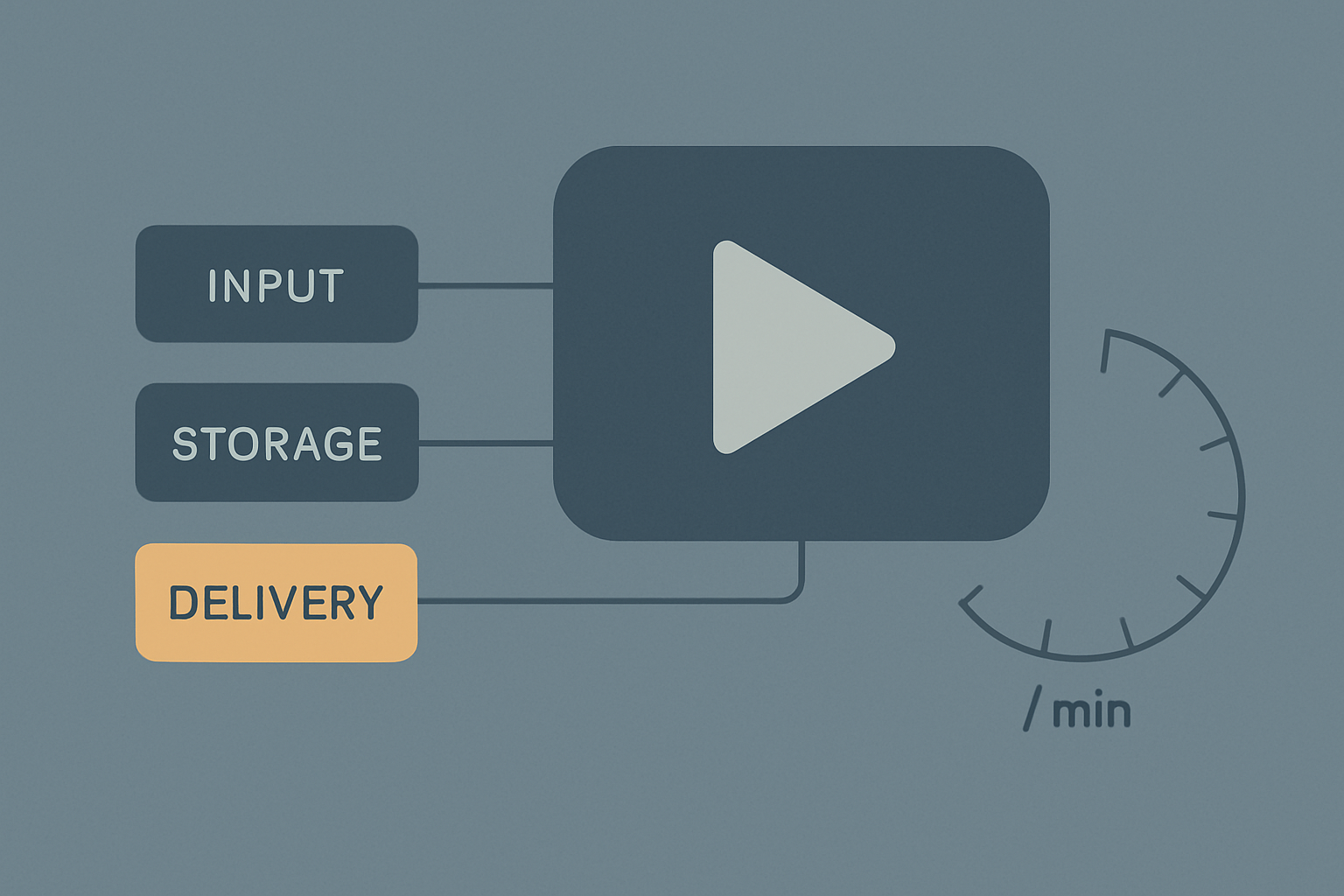
Mux Video splits every dollar into four usage meters (Mux pricing, July 2026):
- Input is what you pay to encode an uploaded file. On the Basic quality tier it is free. On Plus it starts at $0.025 per minute and on Premium at $0.0384 per minute.
- Storage is charged per minute of video held, per month. It is $0.0024 per minute per month at 720p.
- Delivery is charged per minute streamed to viewers, after a standing free allowance of 100,000 delivery minutes every month. It is $0.0008 per minute at 720p.
- Mux Robots is the AI workflow meter: summaries, chapters, moderation, caption translation, thumbnails and similar jobs run on on-demand assets. It bills in units rather than minutes, at 1,000 units per $0.01, with the first 100,000 units free every month on every plan including Free (Mux docs, pricing overview, 2026). Most workflows charge a per-job fee plus a per-minute fee on the asset duration.
Resolution is a flat multiplier applied to storage and delivery: 1080p is 1.25x, 2K is 2x, and 4K is 4x the 720p base (Mux docs, pricing overview, 2026). Premium adds another 1.5x on top of storage and delivery. Mux Data (analytics) and Mux Player are free.
Scroll to see more
| Line item | 720p | 1080p (1.25x) | 4K (4x) |
|---|---|---|---|
| Input (Basic tier) | Free | Free | Free |
| Storage, per min / month | $0.0024 | $0.003 | $0.0096 |
| Delivery, per min | $0.0008 | $0.001 | $0.0032 |
First 100,000 delivery minutes each month are free on every paid plan.
The real 30-day bill: three cohorts
All three assume the Basic tier (free encoding) and 1080p, which is where most on-demand apps actually sit.
Cohort 1: the side project
A small course app with 40 hours of video stored and 80,000 minutes watched in the month.
- Storage: 40 hours = 2,400 minutes x $0.003 = $7.20
- Delivery: 80,000 minutes is under the 100,000 free allowance = $0
- Input: Basic tier = $0
- Total: about $7.20 for the month.
At this size Mux is essentially free plus loose change. This is the range where the 100,000 free delivery minutes do all the work.
Cohort 2: the growing platform
A creator platform with 400 hours stored and 500,000 minutes watched.
- Storage: 400 hours = 24,000 minutes x $0.003 = $72
- Delivery: 500,000 minus 100,000 free = 400,000 x $0.001 = $400
- Input: $0
- Total: about $472 for the month.
Notice the shape. Delivery ($400) is more than five times storage ($72), and encoding is zero. The bill is a viewing bill, not a hosting bill.
Cohort 3: the same platform, in 4K
Identical library and identical audience as Cohort 2, but served at 4K instead of 1080p.
- Storage: 24,000 minutes x $0.0096 = $230
- Delivery: 400,000 billable minutes x $0.0032 = $1,280
- Total: about $1,510 for the month.
Same content, same viewers, roughly 3.2x the bill. Nothing changed except a resolution setting. That is the single most expensive decision in the Mux console, and it is one checkbox.
The plans on top of the meters
The four meters above are the core of the bill. The named plans mostly decide how you pre-pay for them (Mux pricing, July 2026):
- Free: 100,000 delivery minutes a month, up to 10 stored videos, on-demand only.
- Pay as you go: a $20 monthly usage credit, then metered.
- Pre-pay Launch: $20 a month for $100 of credit.
- Pre-pay Scale: $500 a month for $1,000 of credit, which is the first real volume discount.
- Enterprise: additional discounts once you are past roughly $3,000 a month.
A few extras sit outside the core meters and surprise people: live simulcasting at $0.020 per minute per target, media-grade DRM at $100 a month plus $0.003 per play, and custom streaming domains at $100 a month.
Mux versus the alternatives


For a managed video API, the honest comparison set is Cloudflare Stream and Bunny Stream. Cloudflare Stream prices storage and delivery in round per-1,000-minute units and folds encoding in, which is simpler to forecast but can be pricier at low delivery volumes. Bunny Stream leans on cheap bandwidth and is often the lowest headline rate, at the cost of Mux's per-title encoding, analytics, and player polish. Mux's advantage is not the sticker price; it is that Mux Data and Mux Player are free and genuinely good, so you are buying an integrated stack rather than raw delivery. If you only need to move bytes, Bunny usually wins on cost. If you need quality-of-experience analytics baked in, Mux earns its meter.
Four levers that lower a Mux bill
- Stay on Basic. Input is free on Basic and its intelligent bitrate is fine for most on-demand catalogs. Plus and Premium only pay off if you actually use their extra features; otherwise you are adding a $0.025-per-minute encoding charge for nothing.
- Cap your delivery resolution. If your audience watches on phones, serving 4K is paying 4x delivery for pixels no one sees. Defaulting to 1080p instead of 4K is the biggest single saving available, as Cohort 3 shows.
- Use the free 100,000 delivery minutes deliberately. That allowance is roughly 1,666 hours of viewing a month. Small and mid apps can run near $0 on delivery if they stay inside it, so watch the line before you assume you have outgrown it.
- Prune dead assets, knowing what they already cost. Mux runs automatic cold storage, so storage price depends on exactly whether anyone watches: an asset with no play for 30 days moves to
Infrequentat a 40 percent discount, and at 90 days toColdat a 60 percent discount, with a newly created asset starting inColduntil its first play (Mux docs, automatic cold storage, 2026). At 1080p that is $0.003 per minute per month hot, $0.0018 infrequent and $0.0012 cold. An abandoned draft is therefore already billing at 40 percent of the headline rate before you touch it, so deleting it saves that 40 percent and not the full sticker. Pruning still pays on a large library, and any play resets the timer for the whole asset.
Mux is not the cheapest way to host a single video, and it does not pretend to be. It is priced as a metered stack where the delivery line dominates and the resolution multiplier is the lever you control. Model the delivery minutes first, pick the lowest resolution your audience actually needs, and the rest of the bill takes care of itself.
Written by
Diego AguirreFrequently asked questions
Is Mux free to start in 2026?
Yes. Mux has a free plan that includes 100,000 delivery minutes per month, up to 10 stored videos, and on-demand streaming. Small apps that stay inside that allowance pay only for storage, which runs a few dollars a month. Input (encoding) is also free on the Basic quality tier.
What does Mux actually charge for?
Four separate meters. Three are video: input (encoding an uploaded file, free on Basic), storage (per minute of video held, per month), and delivery (per minute streamed to viewers, after 100,000 free minutes). The fourth is Mux Robots, the AI workflow meter, billed in units at 1,000 units per $0.01 with the first 100,000 units free each month. For most apps delivery is the dominant cost because you pay it every time someone presses play.
How much is Mux delivery per minute?
Delivery is $0.0008 per minute at 720p, $0.001 at 1080p, and $0.0032 at 4K, charged only after the first 100,000 delivery minutes each month. Resolution is a flat multiplier: 1080p is 1.25x the 720p base, 2K is 2x, and 4K is 4x.
Why is my Mux bill higher than expected?
Almost always because of delivery volume or resolution. Delivery is billed every time a viewer watches, so a popular library compounds fast, and serving 4K multiplies both storage and delivery by four versus 720p. Encoding and storage are usually minor by comparison.
What does a real Mux bill look like?
A creator platform storing 400 hours of 1080p video and serving 500,000 watched minutes a month pays about $72 storage plus $400 delivery, roughly $472 total on the Basic tier. Served at 4K instead, the same usage costs about $1,510.
Is Mux cheaper than Cloudflare Stream or Bunny Stream?
Not usually on headline delivery cost. Bunny Stream tends to be the cheapest on raw bandwidth and Cloudflare Stream is simpler to forecast. Mux's value is the integrated free analytics (Mux Data) and player, so you are paying for a full stack rather than the lowest per-minute rate.
How can I lower my Mux costs?
Stay on the free Basic encoding tier, cap delivery resolution at the level your audience actually watches (1080p instead of 4K saves the most), keep usage inside the 100,000 free monthly delivery minutes where possible, and prune stored assets no one watches, remembering that Mux already discounts those automatically by 40 percent after 30 days without a play and 60 percent after 90, so deleting a cold asset saves the 40 percent of the headline rate you are still paying.
Related reading

Cloudflare R2 Pricing in 2026: What You Actually Pay
Cloudflare R2 pricing in 2026 charges for storage and operations but never for egress: Standard storage is $0.015/GB-month, Class A writes $4.50/million, Class B reads $0.36/million, with a permanent free tier of 10 GB plus 1M/10M operations. Free egress is the whole pitch, and it moves your bill onto operations, not gigabytes. Below: three real 30-day bills versus Amazon S3 and Backblaze B2, and the Infrequent Access trap that doubles a write-heavy bill.

Cloudinary Pricing in 2026: What You Actually Pay
Cloudinary pricing in 2026 runs on credits: 1 credit equals 1,000 transformations, 1 GB of managed storage, or 1 GB of net delivery bandwidth. Free gives 25 credits, Plus is $99/mo ($89 annual) for 225 credits, and Advanced is $249/mo ($224 annual) for 600 credits. Because credits are one shared pool, delivery bandwidth is usually the line that runs out first, and it works out to roughly $0.40 per GB, far above a raw CDN.

Northflank Pricing 2026: What You Actually Pay
Northflank pricing in 2026 is a per-hour meter on the vCPU and memory you allocate: $0.01667 per vCPU-hour and $0.00833 per GB-hour, plus $0.15/GB-month disk and $0.06/GB egress. The named nf-compute plans are just that meter times 720 hours, not discounts, and the bill is almost always dominated by memory you requested and never used.