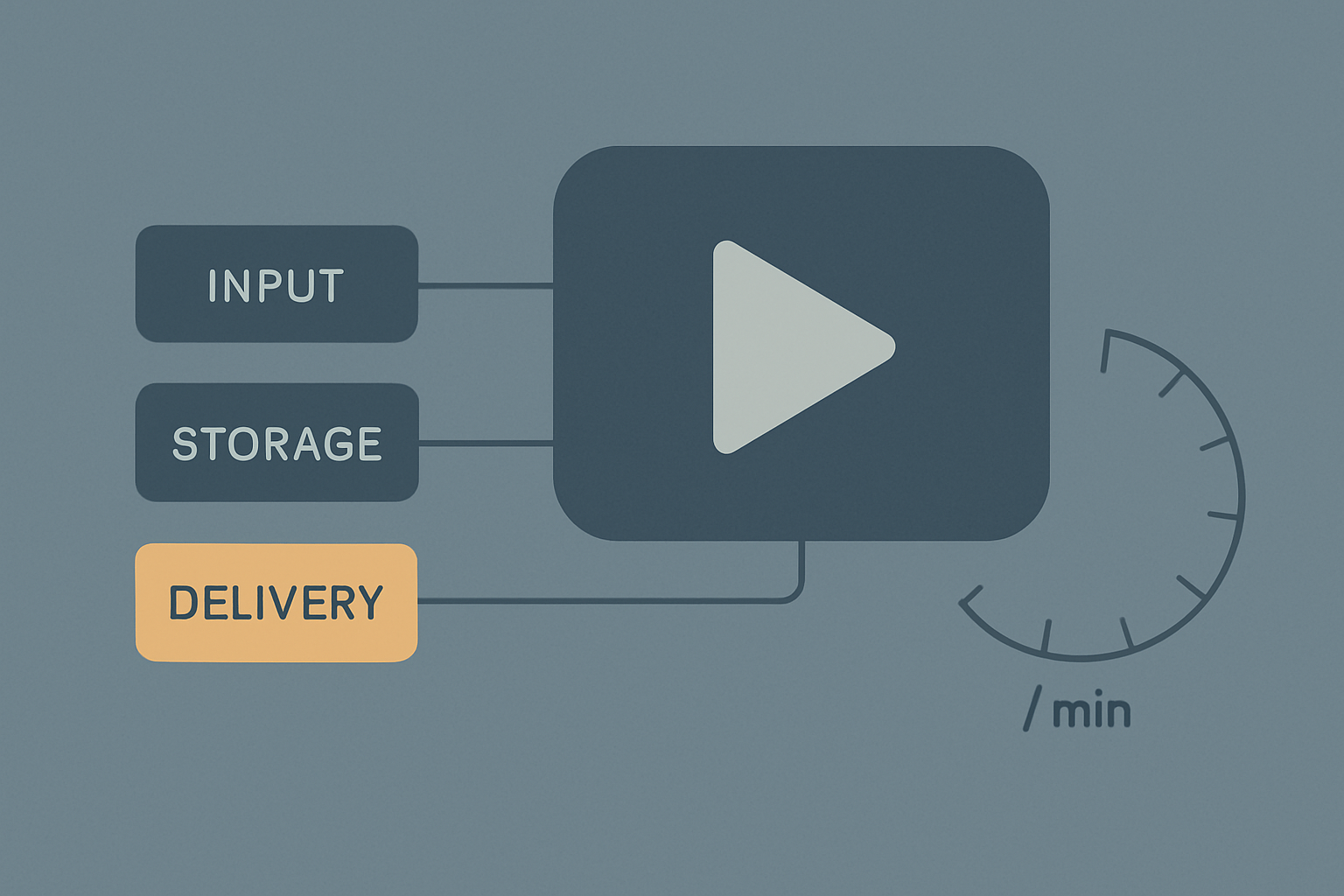
Mux bills video in three meters, not one plan price. Here is the real 2026 arithmetic: worked 30-day bills for three app sizes, the resolution multiplier that quietly quadruples costs, and four levers that lower the bill.
Pinecone runs on usage-based serverless pricing in 2026: a free Starter tier, a $20/month flat Builder plan, and a Standard plan with a $50/month minimum. You pay $16 per million read units, $4 per million write units, and $0.33 per GB of storage each month. The catch most teams miss: a query costs one read unit per GB of namespace size, not per query, so your bill is set by how you shape your namespaces, not how many searches you run. A hobby RAG app fits the free tier at $0; a 20 GB single-corpus production app runs about $110/month; a 50-million-vector multi-tenant app with per-tenant namespaces lands near $75.
Cloudflare Workers bills CPU time, not duration, which inverts everything you know from AWS Lambda. Here is the 2026 pricing, three worked monthly bills, and the 3-millisecond breakpoint that decides your cost.
As of July 2026, Algolia uses usage-based pricing with no flat subscription on its self-serve plans: a free Build tier (10K searches and 1M records a month), then Grow at $0.50 per 1,000 search requests and $0.40 per 1,000 records past the free allowance. Because search requests dominate at scale, the same store can cost $0 on the free tier, about $226 a month while growing, or roughly $1,655 a month at high traffic. Your bill is driven by search volume and replica count, not by raw data size.
As of July 2026, SendGrid no longer has a permanent free plan: the floor is a 60-day trial then Essentials at $19.95/mo (50,000 emails). Pro starts at $89.95/mo (100,000 emails plus one dedicated IP). Your real bill is the base price plus per-email overage ($0.0013 on the 50K plan, $0.0009 on 100K, $0.0011 on entry Pro). A 10K/mo sender pays a flat $19.95; 200K/mo on Pro runs about $199.95 if you eat overage.
Neon bills Postgres by the CU-hour with scale-to-zero. Here is the 2026 rate card, the always-on trap that 5x-es your bill, three worked 30-day bills, and the crossover versus a fixed instance.
Render's advertised prices hide the real bill. In 2026 your cost is three stacked layers: a workspace plan, per-service compute, and metered usage. A solo production app starts near $13/mo (not $7), a small team app around $115/mo. Here is the arithmetic, with three worked 30-day bills.
Cloudinary pricing in 2026 runs on credits: 1 credit equals 1,000 transformations, 1 GB of managed storage, or 1 GB of net delivery bandwidth. Free gives 25 credits, Plus is $99/mo ($89 annual) for 225 credits, and Advanced is $249/mo ($224 annual) for 600 credits. Because credits are one shared pool, delivery bandwidth is usually the line that runs out first, and it works out to roughly $0.40 per GB, far above a raw CDN.
As of July 2026, Lovable costs $0 (Free, 5 build credits/day up to 30 a month), $25/month (Pro, 100 credits), or $50/month (Business, the same 100 credits plus SSO and governance); Enterprise is volume-based. A credit buys a variable amount of work: 0.50 to 1.70 credits per action in Default Mode, or 1 credit per message in Plan Mode. That puts the effective rate around $0.25 per credit on Pro and $0.50 on Business. Budget by credits-per-feature, not the sticker.
Sentry pricing in 2026 is event-based: a free Developer plan, Team at $26/mo and Business at $80/mo (billed annually), each including 50,000 errors, 5M tracing spans, 50 replays and 5 GB of logs. Everything above that baseline is pay-as-you-go, and that overage, not the sticker, is your real bill. Errors run about $0.15 to $1.11 per 1,000 and spans about $1.60 to $4.00 per million, so tracing usually dominates. Below: the full per-unit ladder, three modeled 30-day bills, and why the Business plan includes the same base quotas as Team at three times the price.
Cloudflare R2 pricing in 2026 charges for storage and operations but never for egress: Standard storage is $0.015/GB-month, Class A writes $4.50/million, Class B reads $0.36/million, with a permanent free tier of 10 GB plus 1M/10M operations. Free egress is the whole pitch, and it moves your bill onto operations, not gigabytes. Below: three real 30-day bills versus Amazon S3 and Backblaze B2, and the Infrequent Access trap that doubles a write-heavy bill.
Resend pricing in 2026 runs from a permanent Free tier (3,000 emails per month, capped at 100 per day) to Pro at $20 per month for 50,000 emails or $35 for 100,000, then Scale from $90 up to $1,150 per month for 2.5 million emails, with $0.90 per 1,000 overage. The catch the pricing page hides: your real cost is the effective price per 1,000 emails, which swings from $0.40 to $3.33 on the same $20 plan depending on how full your tier is. Budget by the tier you actually fill, and watch the separate marketing-contacts meter.