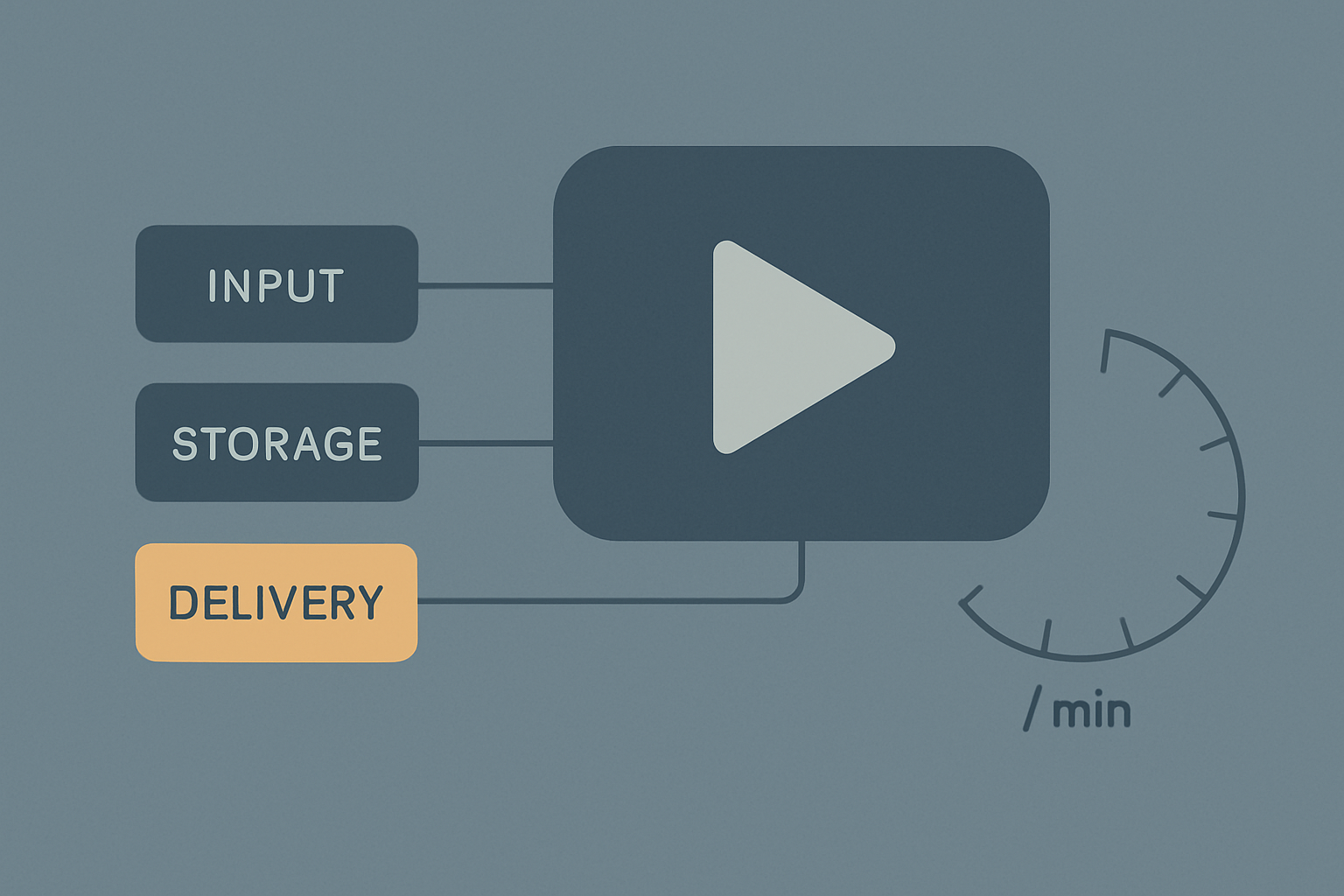
Mux bills video in three meters, not one plan price. Here is the real 2026 arithmetic: worked 30-day bills for three app sizes, the resolution multiplier that quietly quadruples costs, and four levers that lower the bill.
Cloudflare Workers bills CPU time, not duration, which inverts everything you know from AWS Lambda. Here is the 2026 pricing, three worked monthly bills, and the 3-millisecond breakpoint that decides your cost.
As of July 2026, SendGrid no longer has a permanent free plan: the floor is a 60-day trial then Essentials at $19.95/mo (50,000 emails). Pro starts at $89.95/mo (100,000 emails plus one dedicated IP). Your real bill is the base price plus per-email overage ($0.0013 on the 50K plan, $0.0009 on 100K, $0.0011 on entry Pro). A 10K/mo sender pays a flat $19.95; 200K/mo on Pro runs about $199.95 if you eat overage.
Neon bills Postgres by the CU-hour with scale-to-zero. Here is the 2026 rate card, the always-on trap that 5x-es your bill, three worked 30-day bills, and the crossover versus a fixed instance.
Cloudinary pricing in 2026 runs on credits: 1 credit equals 1,000 transformations, 1 GB of managed storage, or 1 GB of net delivery bandwidth. Free gives 25 credits, Plus is $99/mo ($89 annual) for 225 credits, and Advanced is $249/mo ($224 annual) for 600 credits. Because credits are one shared pool, delivery bandwidth is usually the line that runs out first, and it works out to roughly $0.40 per GB, far above a raw CDN.
As of July 2026, Lovable costs $0 (Free, 5 build credits/day up to 30 a month), $25/month (Pro, 100 credits), or $50/month (Business, the same 100 credits plus SSO and governance); Enterprise is volume-based. A credit buys a variable amount of work: 0.50 to 1.70 credits per action in Default Mode, or 1 credit per message in Plan Mode. That puts the effective rate around $0.25 per credit on Pro and $0.50 on Business. Budget by credits-per-feature, not the sticker.
Resend pricing in 2026 runs from a permanent Free tier (3,000 emails per month, capped at 100 per day) to Pro at $20 per month for 50,000 emails or $35 for 100,000, then Scale from $90 up to $1,150 per month for 2.5 million emails, with $0.90 per 1,000 overage. The catch the pricing page hides: your real cost is the effective price per 1,000 emails, which swings from $0.40 to $3.33 on the same $20 plan depending on how full your tier is. Budget by the tier you actually fill, and watch the separate marketing-contacts meter.
Clerk's Free plan covers 50,000 monthly retained users (MRU) in 2026, so most side projects and early-stage SaaS pay $0. Pro is $25/month with 50,000 MRU included, then $0.02 per user in the 50,001 to 100,000 band. The bill that surprises teams is not per-user overage; it is the feature add-ons, B2B Auth at $100/month, Administration at $100/month, and extra Enterprise SSO connections at $75/month each. Clerk also bills retained users, not signups, so anyone who does not return 24 hours after signing up costs nothing.
Twilio charges $0.0083 per SMS segment in the US as of 2026, but that sticker price is not what lands on your bill. Carrier pass-through fees ($0.0025 to $0.0062 per segment), A2P 10DLC registration charges, number rental, and multi-segment messages typically push the real delivered cost to $0.012 to $0.025 per message, roughly 1.5x to 3x the advertised $0.0083.
Stripe's US rate in 2026 is 2.9% + $0.30 per online card charge with no monthly fee, but the flat 30-cent fee and five add-on meters (international +1.5%, currency conversion +1%, instant payouts 1.5%, disputes $15, Billing 0.7%) push most businesses to an effective 3.2% to 13%. Your real rate is a function of your average order value and how you get paid.
Railway pricing in 2026 is usage-based: you pay $20 per vCPU and $10 per GB of RAM per month, billed by the second, plus $0.05 per GB of egress and $0.15 per GB of volume storage. Hobby is $5 a month with $5 of usage included; Pro is $20 a month per workspace, not per seat, with unlimited seats and $20 of usage included. There is no permanent free tier, only a 30-day $5 trial, so a small always-on app runs about $5 to $22 a month and a modest production stack near $70.
Auth0's free tier is 25,000 MAU, but the moment a real app needs one paid feature the meter starts near $0.07 per user. A numbers-first 2026 teardown across four app profiles, with the SSO wall and cheaper alternatives priced out.